
Disclosure: This is an independent editorial review. YourBookBound is not affiliated with the author’s estate, publishers, or any screen adaptation. This article discusses the full story, including its ending.
Some children’s books reassure us that love keeps precious things safe. The Velveteen Rabbit makes a more unsettling promise: love will change them.
Margery Williams’s brief illustrated tale first appeared in 1922. A century later, its central idea still cuts through the machinery of modern childhood. A toy rabbit wants to become “Real,” and the wise Skin Horse tells him that realness is not a manufacturing feature. It is something bestowed by sustained attention, play, dependence, and time. The bargain is beautiful, but it is not gentle. To be loved is to be worn down. To become irreplaceable is also to become impossible to preserve unchanged.
That tension is why the book lasts. It is not merely a sentimental story about a stuffed animal. It is a compact meditation on how identity is made through relationship—and on why the marks left by a relationship may matter more than the object’s original perfection.
The story in brief
The Rabbit arrives on Christmas morning looking splendid, but novelty moves quickly around him. Mechanical toys boast about their modern features, while he feels plain and obsolete. His fortunes change almost by accident when the Boy’s usual bedtime toy cannot be found. The Rabbit is pulled from the cupboard, taken into bed, and gradually becomes the Boy’s constant companion.
Play alters him. His fur grows shabby, his tail loosens, and the color wears from his nose. These are not signs of neglect; they are evidence of participation. When the Boy insists that Bunny is not a toy but “REAL,” the Rabbit understands that the nursery magic has already happened.
Then the story changes register. The Boy becomes seriously ill with scarlet fever. After his recovery, the doctor orders the contaminated bedding, books, and toys burned. The Rabbit is discarded with the infected things and faces destruction just as he believes love has made him real. A fairy finally transforms him into a living rabbit, and the closing scene lets him return, unseen and unrecognized, to the child who first gave him that reality.
“Real” has two meanings—and the book needs both
The most famous exchange comes early. The Skin Horse explains, “Real isn’t how you are made. It’s a thing that happens to you.” The line is often detached from the story and used as a warm quotation about authenticity. In context, it is more demanding.
The Rabbit first becomes real to the Boy. This is private reality: the kind created inside a relationship. The Boy’s declaration does not alter the Rabbit’s body or convince the wild rabbits. It changes the meaning of the toy. For one child, Bunny is no longer interchangeable with another stuffed rabbit, even a newer and more impressive one.
The fairy later makes the Rabbit real to everyone. This is public, physical reality. He receives hind legs, living fur, movement, and a place among other rabbits. The second transformation matters because the first one does not protect him. The adults still see an infected object. The wild rabbits still see an imitation. Love gives the Rabbit an inner status, but it cannot make every observer share that vision.
Williams refuses to collapse those meanings. A person can be fully known within one bond and still be misread by the wider world. The book’s fantasy ending does not erase that pain; it answers it by imagining a reality that no longer depends on anyone else’s recognition.
Wear is the book’s visual language of love
The Rabbit begins as a product: new, decorative, and carefully described. The mechanical toys measure value through complexity, price, and technical vocabulary. The Rabbit cannot compete on those terms. He has no mechanism, no prestige, and not even an accurate idea of what a living rabbit looks like.
But the story gradually replaces product value with use value. A polished surface proves only that an object has survived untouched. The Rabbit’s bald patches, faded colors, and weakened seams record nights of comfort, whispered games, garden expeditions, and the pressure of a sleeping child’s arms. His appearance becomes a material biography.
This is a surprisingly radical idea for a Christmas-toy story. Newness is not the highest state an object can achieve. Perfection can indicate distance. Damage can become legible as history.
That does not mean every damaged possession must be kept forever, or that love is proved by suffering. The Skin Horse’s philosophy is persuasive partly because it is spoken inside a nursery, where objects safely absorb the consequences of human attachment. Adult readers should be careful not to turn the metaphor into a rule for human relationships. The book is strongest when “wear” means evidence of shared life, not permission to endure harm.
The mechanical toys are more than comic villains
The clockwork toys are easy to dismiss as shallow snobs, but they sharpen the book’s argument. They confuse simulation with reality. Because they buzz, move, or possess technical parts, they assume they are closer to life. Their confidence depends on features that will eventually fail.
The Rabbit has almost no features. His limitation makes room for projection. The Boy supplies voice, movement, burrows, adventures, and companionship. In that sense, the simplest toy becomes the most imaginative one—not because simplicity is automatically superior, but because the relationship does more of the creative work.
For present-day readers, the contrast can invite an easy “screens bad, simple toys good” conclusion. The story deserves better. Its real distinction is not between old and new technology. It is between objects that advertise themselves and experiences that acquire meaning through attention. A sophisticated toy can be deeply loved; a handmade one can be ignored. The book asks where meaning comes from, not which materials are morally pure.
Why the scarlet-fever episode changes everything
Without the illness, The Velveteen Rabbit would remain a tender parable about a toy becoming special. Scarlet fever turns it into a story about the limits of sentimental value.
The adults’ decision is harsh from the Rabbit’s point of view but understandable within the world of the story. They are protecting a recovering child. The Rabbit’s private history cannot override a public-health judgment. That conflict gives the book unusual emotional honesty: love does not always save the physical thing that carries its memory.
The new white bunny is especially painful because it demonstrates that adults can replace an object without replacing a relationship. To them, the category “bedtime toy” has been refilled. To the old Rabbit, the shared life has been erased. To the Boy, distracted by recovery and the promised seaside trip, the loss has not yet fully arrived.
Parents may want to preview this section before reading aloud. Children who are anxious about illness, contamination, losing a comfort object, or fire may need reassurance and time to ask questions. The story can support a valuable conversation, but its gentleness should not be mistaken for emotional lightness.
What the ending gives—and what it cannot restore
The fairy’s arrival is both rescue and compensation. She saves the Rabbit from the bonfire and grants the physical life he once envied. Yet the transformation also ends the form of intimacy that made him real in the first place. A living rabbit cannot return to the Boy’s bed as the same companion.
The final encounter preserves that bittersweet distance. The Boy notices a familiar look but does not know the rabbit is Bunny. The Rabbit can remember; the Boy can only sense. Their shared past remains real even though it cannot be resumed.
This is the book’s mature insight: a meaningful ending is not always a restoration. Sometimes love changes a thing so completely that returning to its original state would deny what happened. The Rabbit does not become new again. He becomes capable of a different life.
How the writing creates its effect
Williams writes with the calm authority of a storyteller who expects children to tolerate complexity. The narrator moves easily between nursery comedy, sensory detail, quiet philosophy, and genuine peril. Objects speak, but the emotional logic stays precise.
The story also uses repetition well. The question of realness returns in different settings: the toy cupboard, the Boy’s bed, the garden with the wild rabbits, the rubbish sack, and finally the wood. Each setting tests a different definition. Rather than explaining a theme once, Williams places the Rabbit in situations that expose what the definition can and cannot do.
Some period language and assumptions will feel distant. The household hierarchy, medical practice, and almost complete absence of interiority for the Boy reflect the tale’s era and fable-like design. Modern editions vary in format and illustration style, so the rhythm of a read-aloud can also depend heavily on the edition in hand.
Questions to discuss after reading
- When does the Rabbit first become real: when the Boy says so, when the fairy changes him, or at another moment?
- Why do the mechanical toys believe they are superior?
- Can something become more valuable as it becomes less perfect?
- Were the doctor and Nana wrong to discard the Rabbit?
- Why does the Boy recognize something familiar at the end without recognizing Bunny completely?
There are no single correct answers. The questions work because the book keeps several truths in tension: the adults are protecting the Boy; the Rabbit is still devastated; private meaning is real; public reality does not always honor it.
Final verdict
The Velveteen Rabbit endures because it respects both a child’s belief and an adult’s knowledge of loss. Its sentiment is earned through abrasion. The Rabbit becomes lovable not by remaining beautiful but by accumulating a history, and the story becomes moving not by promising permanent possession but by allowing transformation to cost something.
For families, it is a rich read-aloud when adults are ready to stay for the conversation afterward. For children’s-book creators, it is also a compact lesson in thematic structure: introduce one clear question, test it in increasingly difficult circumstances, and let the ending deepen rather than merely repeat the answer.
If you are shaping a finished story of your own, the useful lesson is not to imitate the Rabbit, the plot, or the language. It is to ask what your central idea costs your character—and whether the physical form of the book supports the emotional experience you want a child to remember. Our guide to printing one finished children’s book explains the practical file-to-hardcover side once your words and artwork are complete.
Edition and source notes
The original London edition was published by Heinemann in 1922 and credited William Nicholson as illustrator; the catalog record describes 19 pages plus seven illustrated plates. You can check the 1922 edition record at Open Library. The full text used for this review is available through Project Gutenberg, which identifies the work as public domain in the United States. Biographical authority information for Margery Williams Bianco is available from the Library of Congress.
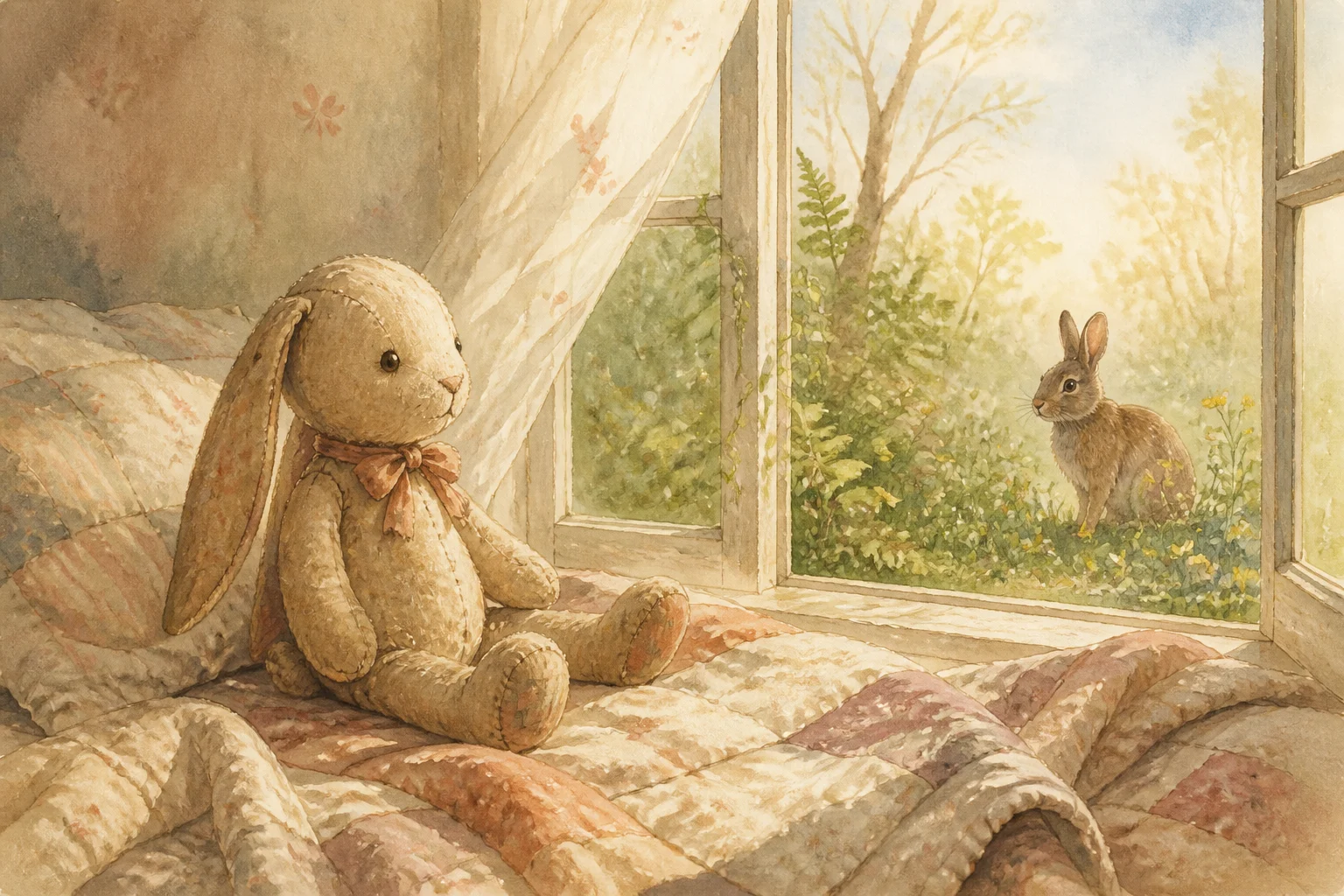
Featured image: original AI-assisted editorial illustration created for YourBookBound. It is not an image from the book and does not reproduce an existing cover or illustration.