
Independent review; spoilers ahead. YourBookBound is not affiliated with Lewis Carroll, any publisher, any rights holder, or any screen adaptation. This review discusses the original novel, not a particular modern edition or adaptation.
Verdict: Alice’s Adventures in Wonderland remains an unusually good family read-aloud when adults resist treating it as a parade of famous characters. Its lasting gift is a child’s-eye experiment in unstable rules: Alice keeps asking what words mean, who gets to decide, and why an instruction deserves obedience. That makes it lively for children who enjoy verbal surprise and useful for adults who want a conversation richer than “Was it silly?” It is also episodic, old-fashioned in spots, and sometimes more fun to share in short stretches than to assign as a solo first chapter book.
What happens, and what kind of book this is
Alice follows a hurried rabbit underground and enters a place where scale, social rank, language, and procedure refuse to stay stable. She grows and shrinks, is ordered about by strangers, moves through a caucus race, a Duchess’s chaotic household, a tea party, a croquet ground, and finally a courtroom. The plot does not build like a modern quest toward a neatly solved external problem. Instead, each encounter tests whether Alice can keep hold of herself while everyone else insists on a new and often nonsensical rule.
That loose, encounter-by-encounter design is the point. Wonderland does not ask a child reader to master a map. It asks the reader to notice a pattern: authority often arrives as noise, confidence, or repetition rather than reason. Alice is not fearless or consistently wise, but she increasingly objects when the conversation stops making sense. The book’s finest motion is not toward a treasure or a moral; it is toward a sharper voice.
The central strength: nonsense has consequences
Many children meet this story through a handful of detachable images. The full text is stranger and more exacting. Its nonsense is not random decoration. Arguments twist because someone changes the meaning of a word, treats an answer as an offense, or announces a rule after the game has already begun. The comedy comes from seeing a social habit made literal and unreasonable.
That gives the book a surprisingly practical value for family discussion. Alice’s confusion is not presented as a personal failure. Often the situation really is incoherent. When she asks follow-up questions, corrects an unfair assumption, or refuses to pretend that a rule is sensible, the reader can see thinking as an action rather than a private trait. For educators, this is an inviting way into conversations about evidence, definitions, turn-taking, and the difference between a rule and a person merely giving an order.
A child protagonist who does not need to be perfect
Alice can be impatient, anxious, proud of what she has memorized, and occasionally tactless. Those flaws keep her from becoming a tiny lecturer who has every answer. She tries to apply schoolroom knowledge in the wrong setting; she apologizes poorly; she loses her temper. Yet she also keeps revising her judgment. That mixture is more persuasive than a lesson about confidence would be on its own.
Her growth is modest but real. Early on, each abrupt change in size or expectation makes her wonder whether she is still herself. By the courtroom scene, she can recognize that the spectacle around her has overreached. The ending therefore feels earned without being sentimental: Alice has not fixed Wonderland. She has become harder to bully inside it.
Language that rewards being read aloud
Carroll’s prose is full of puns, mock lessons, deadpan replies, and poems that tip familiar forms sideways. Some jokes will pass a child listener by, especially if the original schoolroom parodies are unfamiliar. That is not a defect; it creates a genuinely shared reading situation in which adults can wonder aloud rather than explain everything.
Read-aloud pacing matters here. A pause after a badly reasoned statement lets children identify the snag before an adult labels it. Giving each speaker a distinct but simple voice helps the social absurdity land. The short chapters also make natural stopping places, which is fortunate because a long uninterrupted session can flatten the book’s quick verbal rhythm.
Illustrations and edition differences deserve care
The story is inseparable from a long visual history, but this review is about the text rather than any one image program. John Tenniel is credited alongside Carroll in a digitized 1885 Library of Congress copy, while later editions have used very different illustration approaches. Families selecting a copy should preview its type size, notes, illustrations, and whether it preserves or explains the poems. Those choices can change the reading experience without changing the underlying story.
The publication history is also less tidy than a one-date label suggests. The Library of Congress timeline records a July 1865 issue that was withdrawn and a later reissue; the British Library’s manuscript account describes the abortive 1865 printing and a definitive 1866 edition. That history is a useful reminder to name the edition being discussed when comparing introductions, illustrations, or pagination.
What may not work for every reader
This is not a gentle “nothing bad happens” fantasy. Alice is frightened, physically threatened in comic-book ways, shouted at, and surrounded by adults and creatures who can be rude or domineering. References to punishment and repeated threats of beheading are frequent, even though the tone is absurd rather than graphic. A child sensitive to yelling, unpredictable authority, or anxious dream logic may prefer small portions with an adult.
The book also contains period language and social assumptions. Its humor can depend on Victorian classroom material that modern readers do not automatically recognize. Rather than smoothing that away, a caregiver can say when a joke is built on an old custom or an unfamiliar poem. The aim is not to turn every page into a lecture, but to keep confusion from becoming exclusion.
Discussion questions for families and classrooms
- Which Wonderland rule seems most unfair, and what makes a rule fair instead?
- When Alice is confused, what does she do that helps her understand more?
- Can someone sound confident and still be wrong? Find a moment that shows why.
- What changes when a word is used in an unexpected way?
- Which scene would you want to rewrite so that Alice has more choice? What would change?
Why it still matters to children’s-book makers
The novel is a useful craft study because it trusts a young character with a complicated social world. Its chapters turn on voices, reversals, and concrete situations rather than a running explanation of the theme. Creators working on their own children’s manuscripts can notice how a clear situation gives strange language somewhere to stand. When a manuscript is ready for a physical proof, seeing its own page turns and pauses can reveal whether chapters such as these are carrying the reader forward; that is a production question, not a claim about this book’s publisher or ownership. Our guide to printing one children’s book from a finished story explains that separate practical process.
Final evaluation
Read with patience and a willingness to stop for the funny parts, Alice’s Adventures in Wonderland is more durable than its most famous images. It lets children practice an important distinction: the world can be confusing without their questions being wrong. For ages roughly 7 and up in a shared reading setting, or for independent readers comfortable with older vocabulary, it is an excellent prompt for talk about language and power. The best approach is not to rush toward the scenes everyone already knows. Let the odd conversations do their work.
Sources and text consulted
- Project Gutenberg, Alice’s Adventures in Wonderland — complete legal public-domain text consulted for plot, structure, language, and content notes.
- Library of Congress, Lewis Carroll timeline — consulted for the 1862 origin account and 1865 publication/withdrawal timeline.
- British Library manuscript catalogue: Alice’s Adventures Under Ground — consulted for manuscript development and edition-history context.
- Library of Congress digitized 1885 edition record — consulted to verify the Carroll and Tenniel credits for that copy; not used as a substitute for all editions.
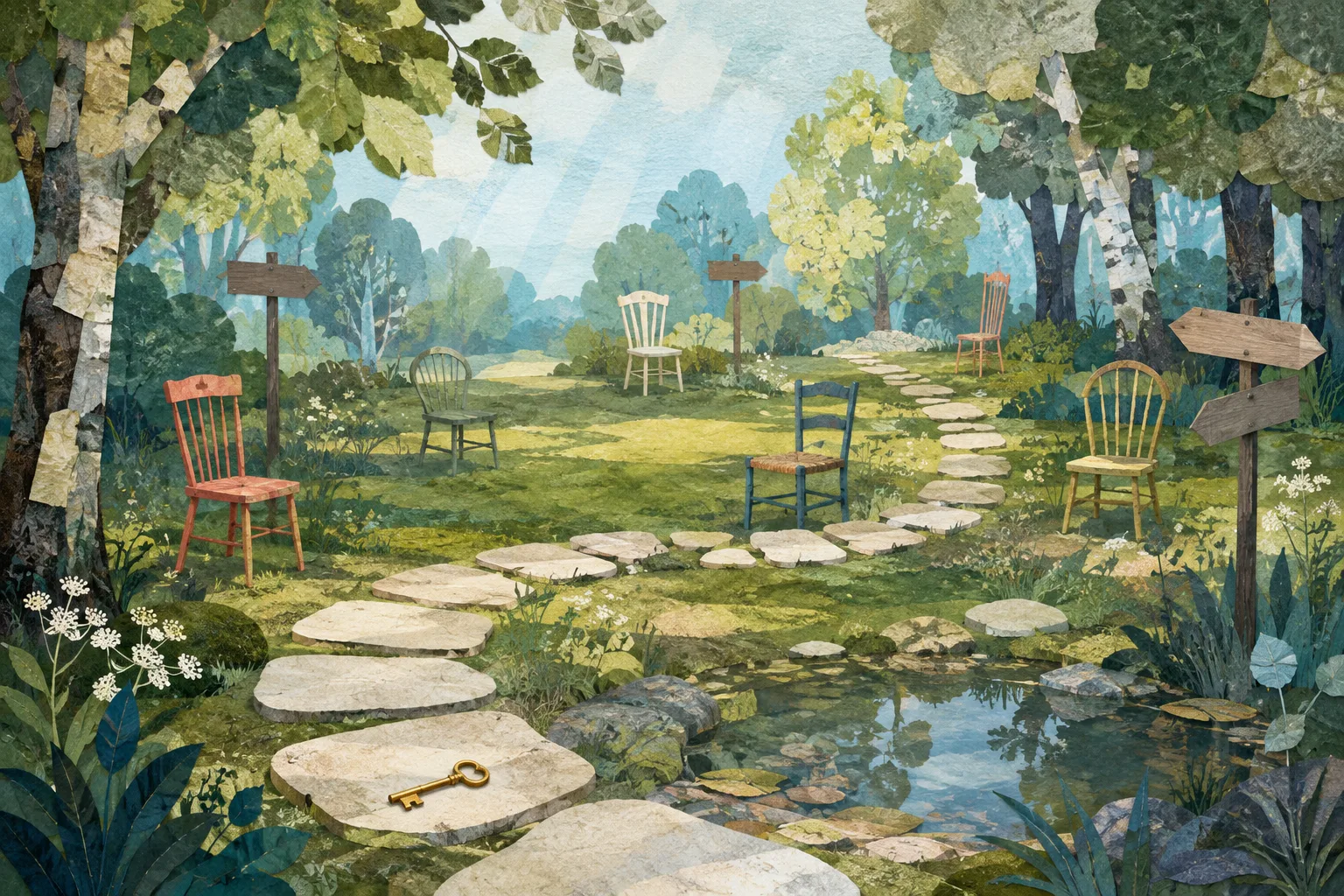
Original AI-assisted editorial illustration created for YourBookBound; not from the book.