
Disclosure: This is an independent editorial review. YourBookBound is not affiliated with Beatrix Potter’s estate, Frederick Warne, any publisher, or any adaptation rights holder. This review discusses the full story, including its ending and its moments of peril.
There is a reason The Tale of Peter Rabbit still makes a good read-aloud after more than a century: it does not pretend curiosity is either purely virtuous or purely bad. Peter is warned away from Mr. McGregor’s garden, goes anyway, enjoys the forbidden abundance, becomes frightened, makes several increasingly poor decisions, and finally gets home. The plot is so familiar that it can look like a simple obedience lesson. It is better—and more useful—than that.
Beatrix Potter’s little book is a tightly designed story about what happens when wanting something pulls a child beyond the map of safety. It gives Peter agency, lets him make a real choice, and refuses to make his escape effortless. The result is brisk, funny, and genuinely tense without turning its young protagonist into a villain.
First commercially published by Frederick Warne in 1902, the story is remarkably compact: a family briefing, one fateful detour, a chase, and a quiet return to the rabbit hole. Readers encounter the work through many editions, whose formats and supplementary materials vary; this review addresses Potter’s original story and its sequence rather than treating any one modern edition’s design as definitive.
The story in brief
Peter lives with his mother and his siblings Flopsy, Mopsy, and Cottontail beneath a fir tree. Mrs. Rabbit permits the children to visit the fields or the lane, but gives one unmistakable instruction: “don’t go into Mr. McGregor’s garden.” The warning has weight because Peter’s father met a grim fate there.
While his sisters gather blackberries, Peter heads directly for the garden and samples its vegetables. Mr. McGregor spots him, and the restful opening becomes a chain of escapes: Peter loses his jacket and shoes, squeezes through a window, hides in a watering can, fails to get an answer from a mouse, and finally finds his way back to the gate. At home, exhausted and ill, he receives chamomile tea while his siblings have the comfortable supper he missed.
The stakes are controlled, not hidden. Mr. McGregor means danger, Peter panics, and the story’s joke about his second lost outfit in a fortnight leaves room for both relief and consequence.
Curiosity is the engine, not a character flaw
It is tempting to describe Peter simply as naughty and stop there. Potter does use that word, but the story gives his choice a more recognizable texture. A well-stocked garden is visible, close, and forbidden; Peter’s siblings choose the ordinary outing, while he chooses the concentrated possibility of the place he has been told to avoid. The book understands why that possibility appeals.
That distinction matters in a family read-aloud. If Peter is only a bad child, the conversation ends at obedience. If he is a child whose appetite and confidence outrun his judgment, readers can ask better questions: What did he expect to happen? When did he first realize he needed help? Which of his choices made the situation harder? The story lets a child identify with Peter without asking them to endorse every decision he makes.
For adults, this is a useful model of consequence without humiliation. Peter is not permanently labeled by his mistake. He does not receive a long lecture or a tidy promise to reform. He gets home shaken, loses his clothes, misses supper, and has a stomachache. The natural aftermath is specific enough to mean something.
Why the chase still works
Potter controls pace by repeatedly narrowing Peter’s options. A gate, a window, a tool-shed, a pond, and a row of currant bushes are not generic scenery; each becomes a decision point. At first Peter runs. Then he hides. Then he loses his sense of direction. Then he has to pause and observe. The garden feels larger as his certainty shrinks.
The narration also knows when to slow down. Peter’s dampness in the watering can, the mouse carrying a pea, and the cat concentrating on goldfish interrupt the chase with vivid, slightly odd details. Those pauses are suspense devices. They make young listeners wait with Peter, and they show that fear can make even a familiar landscape unreadable.
This is one reason the book remains useful to children’s-book creators. The plot does not rely on a grand villain or an elaborate backstory. It arranges space carefully, gives each obstacle a consequence, and lets the reader understand the danger a moment before Peter does. Its economy is a craft lesson, not an excuse for thin storytelling.
The pictures and the text share the work
Potter wrote and illustrated the original tale, and the story’s visual identity is therefore inseparable from its words. Yet it is worth resisting the habit of treating the illustrations as decoration for a verbal moral. The small scale of the original picture-book approach makes Peter appear vulnerable inside a detailed human-managed world: paths, tools, crops, gates, and containers all imply rules that he cannot control.
That relationship between small figure and large environment changes the reading experience. Children can scan an image for Peter’s hiding place or Mr. McGregor’s position before the next sentence confirms the risk. Adults can notice how ordinary domestic and garden objects become huge when a child-sized character has no clear route out.
Modern editions may alter page size, paper, type, reproduction quality, and the placement or treatment of illustrations. Those choices can make a read-aloud feel more spacious or more hurried. If you are choosing a copy for a group, preview the page turns rather than assuming every edition delivers the same rhythm.
The story’s limits are part of the conversation
The book’s world can feel blunt by contemporary standards. Mr. McGregor is not given an inner life; he functions primarily as the force that turns a tempting garden into a dangerous one. Peter’s father’s fate and the threat of being caught may be frightening to some children, even though the prose remains calm. The final joke about Peter’s illness is also an old-fashioned response to stress and excess, not medical guidance.
Parents and educators may want to preview the chase for children who are especially anxious about pursuit, getting separated, or punishment. It can help to name the reassuring facts before or after reading: Peter gets home, his mother cares for him, and the story makes room for safety after a scare. For some young readers, that framing is more helpful than insisting the book is harmless because it is a classic.
There is also a quiet class and power imbalance in the premise: an animal child moves through a cultivated space owned and defended by an adult human. The book does not investigate that conflict. Instead, it uses it to make boundaries immediate. A thoughtful discussion can acknowledge both things—that gardens require care and that a child’s desire to explore is not erased by being told no.
Questions to discuss after reading
- Why do you think Peter chose the garden when he knew the rule?
- What was Peter’s best choice during the chase? What was his riskiest one?
- How does the garden feel different before and after Mr. McGregor sees Peter?
- What consequences does Peter face when he gets home?
- What would make a rule easier to remember when something tempting is nearby?
Who this book suits
The Tale of Peter Rabbit works best for children ready to enjoy a contained scare and to talk about decisions after the action ends. The language is short enough for a read-aloud, but the story rewards a second pass because its route through the garden is so deliberate. It is particularly strong for a parent-and-child conversation, a small classroom discussion about cause and effect, or a creator’s study of how a picture book builds motion.
It is not the best first choice for a child who currently finds chase scenes or threats to animal characters overwhelming. In that case, save it for later or pause at the garden warning and agree on a signal for taking a break. A classic’s longevity is not a requirement that every child meet it on the same day.
Final verdict
The Tale of Peter Rabbit endures because it gives its small adventure a real shape: desire opens the door, panic closes the map, attention finds a route home, and consequence remains after the relief. Potter neither celebrates recklessness nor reduces Peter to it. She makes room for the feeling behind the mistake.
For families, that makes the book more than a nostalgic rabbit story. It is a compact rehearsal for a familiar childhood problem: how to keep curiosity alive while learning that some boundaries are there because the world is larger, stranger, and less forgiving than it first appears. For writers and illustrators preparing a finished children’s-book file for a physical proof, it is also a reminder that page turns, spatial clarity, and a carefully escalated sequence can carry as much meaning as an explicit lesson. For practical next steps once a children’s manuscript is complete, see our guide to printing one copy of a children’s book.
Sources
- Project Gutenberg: The Tale of Peter Rabbit — complete readable text, author identification, and U.S. public-domain notice.
- WorldCat catalog record for The Tale of Peter Rabbit — 1902 Frederick Warne publication record.
- Library of Congress Folklife Today: “Here Comes Peter Cottontail” — context on the tale’s 1901 self-publication and 1902 commercial publication.
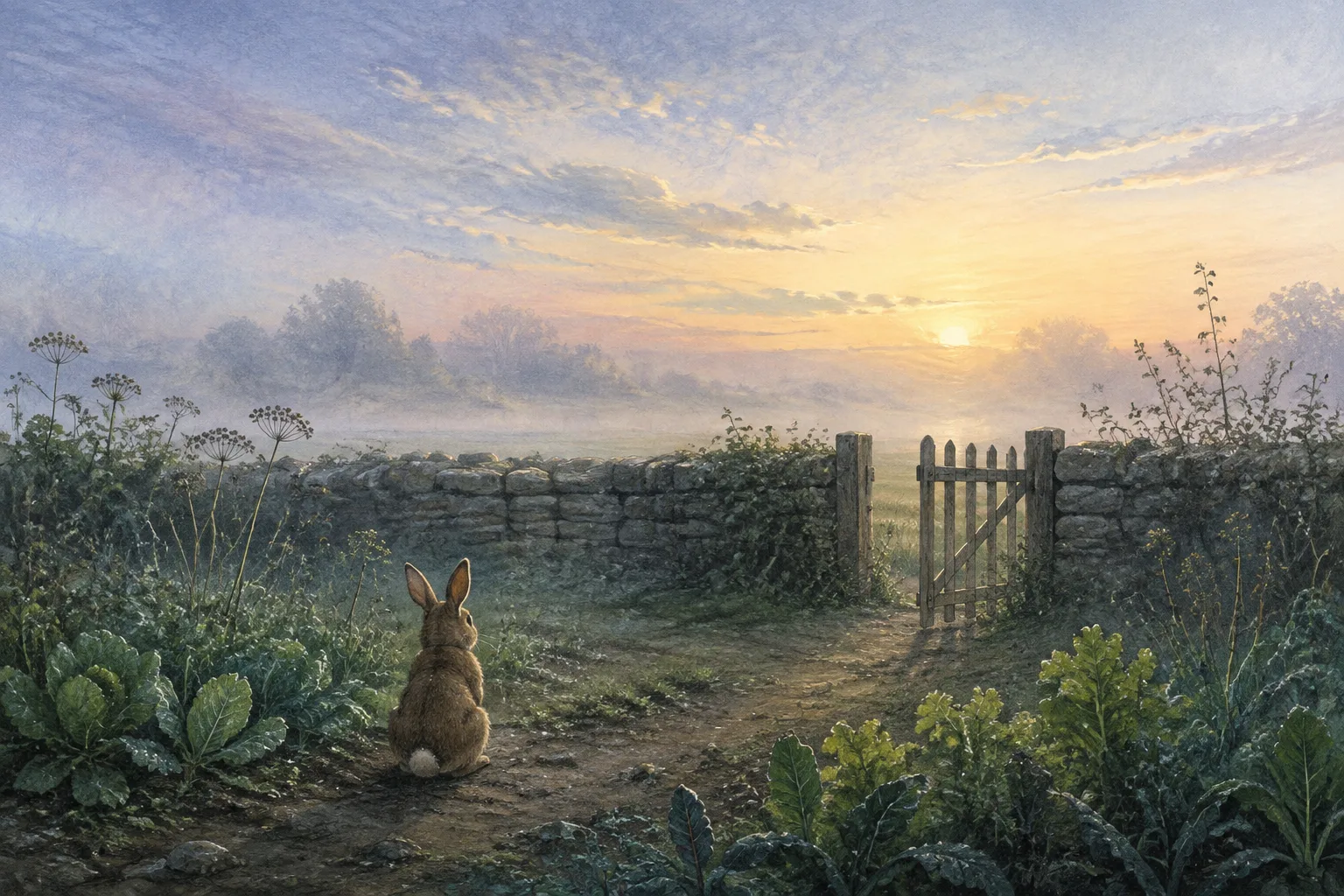
Original AI-assisted editorial illustration created for YourBookBound; not from the book.