
There is no universal winner between hardcover and paperback for a children’s book. Choose the production route first, then compare its current page-count, trim, paper, color, cover, distribution, and cost options. The binding choice changes the physical object, cover template, proof questions, and often the ISBN. Make that choice before final layout and cover production.
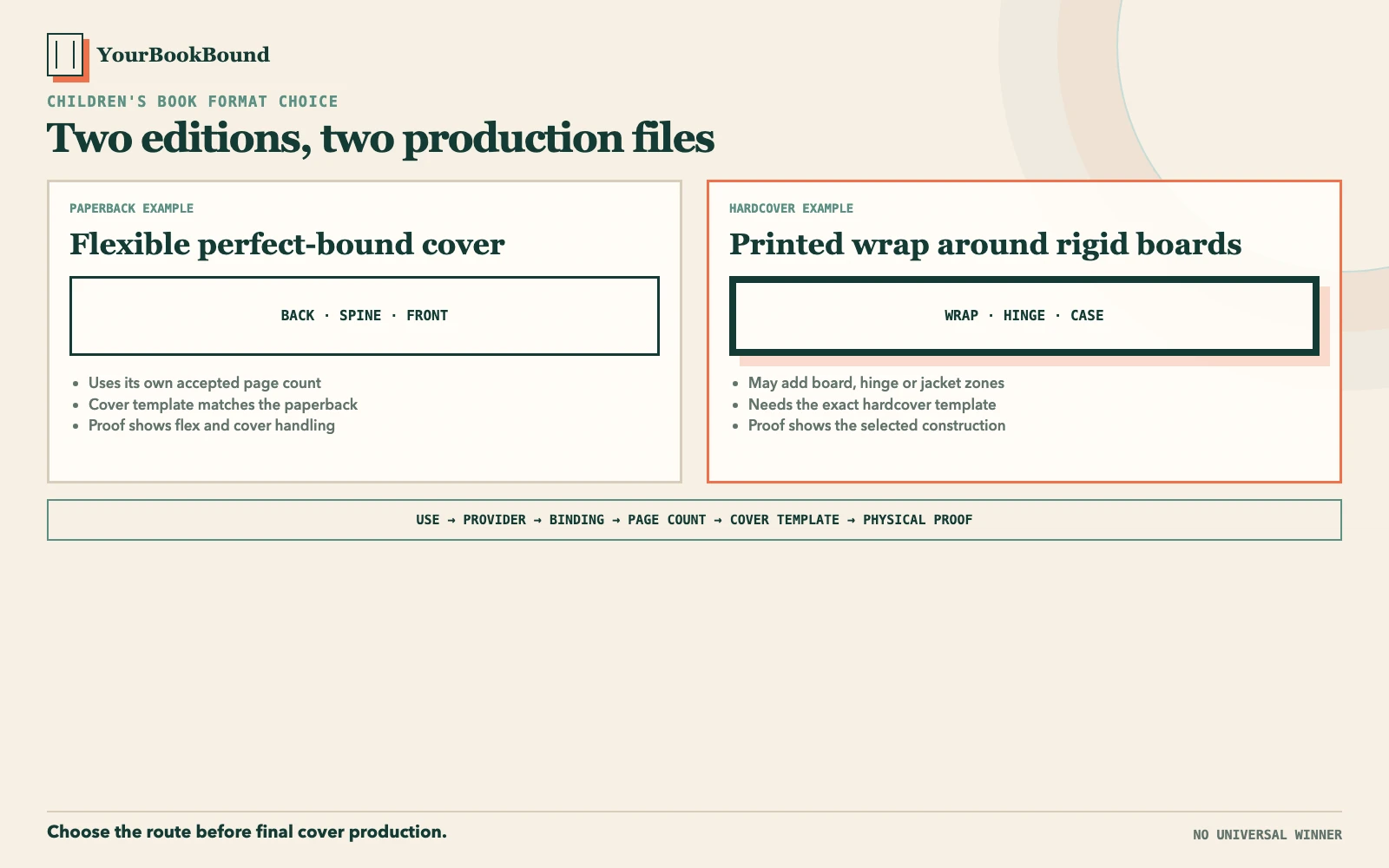
Should a children’s book be hardcover or paperback?
Choose the edition that fits the actual production route and the way you want the finished book to be used. A rigid case-laminate hardcover, a cloth hardcover with a jacket, and a perfect-bound paperback are different products. They do not share one cover file or one universal page-count rule.
If you want one private copy to hold, give, photograph, or examine before a later publishing decision, the object itself may matter more than retail distribution. If you are preparing a published edition, availability, unit cost, list price, ISBN, retailer access, and replacement files also enter the decision.
Short answer: lock the intended provider, binding, trim, paper, color route, page count, and distribution goal before final cover production. Then order the physical edition you actually need to judge.
YourBookBound offers one finished hardcover for a fixed $99 USD, including technical file corrections, interior layout preparation, cover design or adjustment and spine setup, a digital proof and revisions before approval, standard tracked shipping. It does not list a paperback product. The free file check confirms the production plan before payment.
Hardcover and paperback change more than the front cover
A perfect-bound paperback
A common paperback route uses a printed flexible cover wrapped around a glued book block. IngramSpark describes its paperback option as perfect bound. The production cover is normally one file containing the back, spine, and front, but its width and safe areas depend on the selected paper, page count, trim, and provider.
A case-laminate hardcover
A case-laminate hardcover places printed cover art around rigid boards. KDP describes a two-millimetre case board, along with a wrap, endsheets, a spine, and hinges. The cover extends beyond the trimmed interior pages. That geometry is why a paperback wrap cannot simply be renamed and uploaded as a hardcover cover.
Other hardcover constructions
Hardcover is not one universal product. KDP currently offers case laminate without a dust jacket. IngramSpark lists case laminate and Digital Cloth options, with jacket availability depending on the route. Lulu lists casewrap and a linen-wrap dust-jacket product in its current guidance. Each construction needs its own current template.
| Question | Paperback example | Hardcover example |
|---|---|---|
| Cover structure | Flexible laminated cover | Printed wrap around rigid case board |
| Common binding label | Perfect bound | Case laminate or another hard case |
| Extra cover zones | Back, spine, front, bleed | May add wrap, hinge, board, jacket, or flap zones |
| Template | Generated for the paperback specification | Generated for the exact hardcover construction |
| Physical judgment | Flex, opening, spine, trim, color | Board, hinges, opening, wrap, trim, color |
Choose by the real use, not a generic quality label
Start with what the copy must do. A one-off presentation copy, family keepsake, gift, school-reading copy, retail paperback, and bookstore hardcover are not the same assignment. Write down the use before comparing specifications.
If the goal is to inspect a future hardcover edition, print a hardcover. A paperback cannot show how the case projects beyond the pages, how the hinge opens, where artwork wraps around the board, or how the book sits in the hand. The reverse is also true: a hardcover cannot confirm the flex, spine behavior, or cover handling of a planned paperback.
Do not replace this decision with broad claims about age, durability, prestige, or sales. Those claims depend on the exact construction, reader, price, channel, and handling. The useful questions are concrete:
- Which format will actually be sold or used?
- Does the current provider support the page count and trim?
- Is a jacket, casewrap, or flexible cover part of the intended design?
- Will the proof be used to judge layout only, or the final physical format?
- Does the publishing route need a separate ISBN and retail listing?
Provider limits can decide before taste does
A short illustrated story may fit one hardcover route and fail another. Provider rules belong to the named service, not to children’s books as a whole.
Amazon KDP
KDP currently limits its case-laminate hardcover to five trim sizes and 75 to 550 pages. A 32-page picture book therefore does not fit that specific hardcover route, even though short hardcovers exist elsewhere. KDP also states that hardcover is not available for Expanded Distribution.
Lulu
Lulu’s current formatting guidance lists perfect-bound paperback at 32 to 800 pages and casewrap hardcover at 24 to 800 pages. The available binding still depends on the selected book size and page count. Its Global Distribution rules attach separate eligibility notes to paperback, casewrap, and dust-jacket products.
IngramSpark
IngramSpark asks the publisher to choose binding before completing the interior and cover production sequence. Its current material distinguishes perfect-bound paperback from case laminate and other listed hardcover constructions. Availability can change with trim, paper, color, and market.
These examples explain why a blog post cannot pick the format for your file. Check the current product table or submit the real files to the intended provider.
Can the same interior and cover files be reused?
The interior may be reusable only when the specification matches
KDP says the same interior measurements may work for paperback and hardcover when the manuscript meets both products’ trim and page-count requirements. That is conditional, not automatic. Margins, gutter behavior, blank-page handling, paper, and accepted count still need review for each edition.
If the interior contains an ISBN, edition statement, price, or format-specific credit, update it for the new edition. Recheck every page after the new route processes the file.
The cover normally needs a new template
The cover is the clear break point. KDP states that paperback and hardcover measurements differ. Lulu supplies a custom cover template based on paper, binding, size, and page count. A hardcover template may contain board wrap, hinge, jacket, or flap areas that do not exist in a paperback file.
Finalize the accepted interior first. Then generate the current cover template for the exact format. Do not stretch the old cover by eye or keep the spine from a different paper and page count.
Treat ISBN, cost, and distribution as edition decisions
ISBN
A private one-copy proof does not automatically need an ISBN. A published hardcover and paperback are separate formats and normally need separate identifiers. KDP requires a unique ISBN when creating a hardcover from an existing paperback. Lulu also lists a new product format as a reason for a new ISBN.
For the fuller private-copy and publishing distinction, see Do I Need an ISBN to Print One Book?
Cost and list price
Do not assume a current price from the word hardcover or paperback alone. Use the exact provider calculator with trim, page count, color, paper, binding, quantity, destination, and distribution settings. A manufacturing estimate may exclude shipping, tax, file work, or proof preparation.
YourBookBound’s fixed $99 USD service includes file review, technical file corrections, interior layout preparation, cover design or adjustment and spine setup, a digital proof and revisions before approval, one finished hardcover and standard tracked shipping. It is a complete one-hardcover service, so compare its inclusions with a platform’s manufacturing-only quote.
Distribution
Check the intended market before committing. KDP’s current hardcover does not use Expanded Distribution. Lulu attaches different Global Distribution eligibility notes to casewrap, dust-jacket, and perfect-bound products. Availability on one platform does not prove availability through another retailer or country.
Order the proof that answers the physical question
A digital proof checks prepared content and placement on a screen. It cannot reproduce a flexible cover, rigid board, hinge, paper feel, binding resistance, exact printed color, or the way a spread opens.
Use a physical copy to check the selected format:
- front, back, spine, and any wrap or jacket alignment;
- page order, blank pages, and story pacing;
- text and faces near trim or the binding;
- how easily important spreads can be viewed;
- printed color, small type, and fine illustration details;
- whether the object matches the edition you plan to use or sell.
If you are deciding between two commercial editions, one physical format cannot prove the other. Order or inspect each intended construction before approving a larger decision.
Frequently asked questions
Is hardcover always better for a children’s picture book?
No. The answer depends on the intended use, production route, page count, trim, budget, distribution plan, and physical result. Choose the exact edition rather than a generic quality label.
Can a 32-page picture book be a hardcover?
It can on some routes. Lulu currently lists casewrap hardcover from 24 pages, while KDP’s current case-laminate hardcover starts at 75 pages. Those are provider-specific rules.
Can I use my paperback cover for hardcover?
No. Generate a new template for the exact hardcover construction, trim, paper, and accepted page count. The board, wrap, hinge, or jacket geometry differs.
Can I use the same ISBN for both formats?
Not for separate published paperback and hardcover editions. KDP and Lulu both treat a new physical format as needing a separate ISBN. A private one-copy proof is a different use case.
Does YourBookBound print paperbacks?
The $99 USD service includes one finished hardcover and all listed file-preparation services. It does not list a paperback option.
How do I know whether my short book fits?
Other printers have their own page-count and trim rules. YourBookBound has no page-count limit. Common sizes are A5, A4 and 8.5 × 11 inches. Upload the latest interior and an optional cover for a free file check; we confirm the final size, paper and page count with you before payment.
One real hardcover, checked first
Confirm the format with the actual files.
Upload the latest interior and optional cover for a free human check. No payment is required at upload.
Official references
- YourBookBound: Current Fixed Pricing
- YourBookBound: How It Works
- Amazon KDP: Hardcover
- Amazon KDP: Hardcover Print Elements
- Amazon KDP: Book Formatting
- Lulu: Formatting and Page Counts
- Lulu: Global Distribution Print Formats
- Lulu: New Format and ISBN
- Lulu: Custom Cover Template
- IngramSpark: Choose Paperback or Hardcover Binding
- IngramSpark: Print Book Design and Binding Guide