
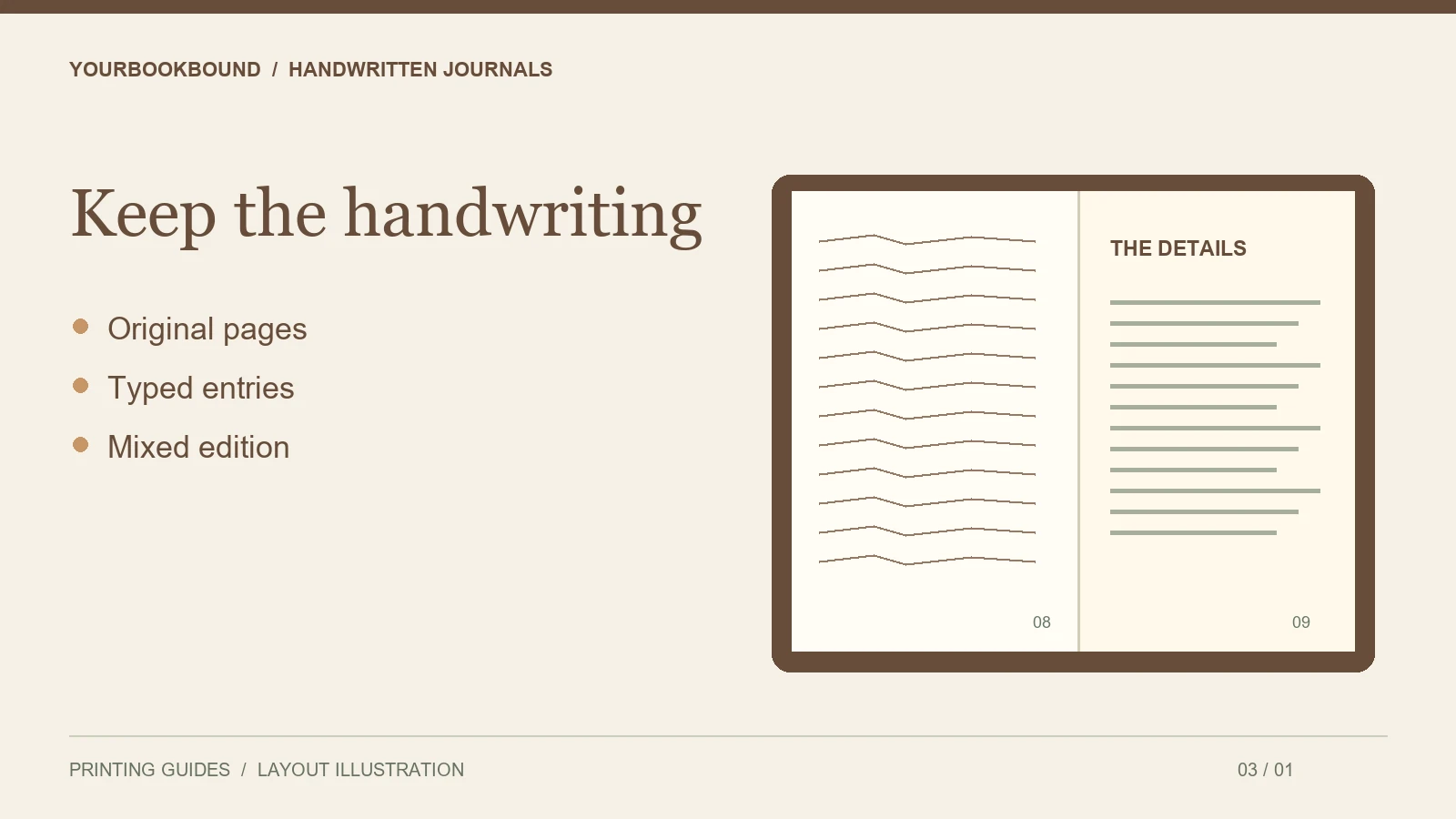
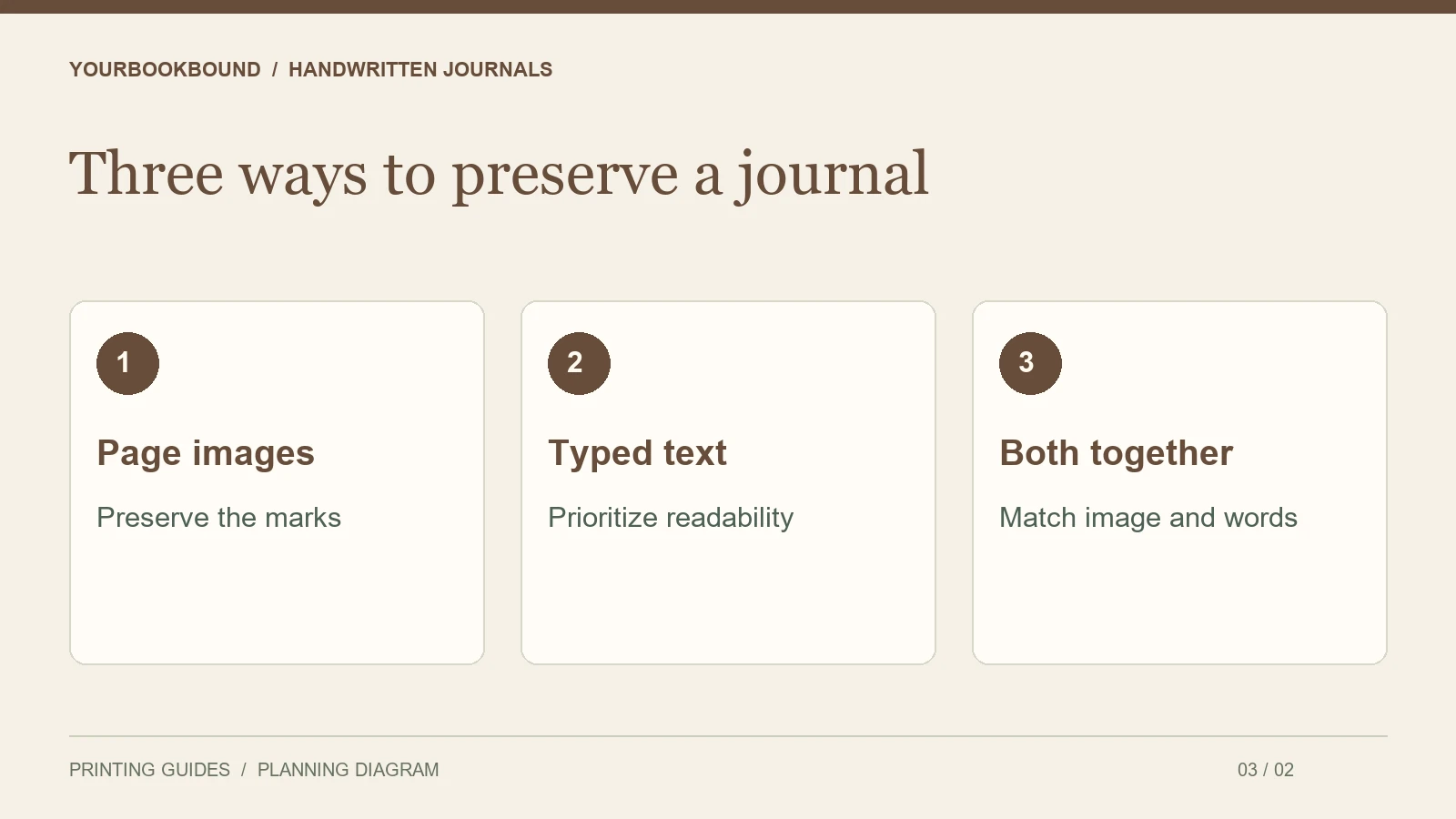
You can turn a handwritten journal into a printed book by reproducing the pages as images, typing the entries, or combining both. Choose the reading experience first. Preserving every mark is a different project from making years of small handwriting easy for someone else to read.
Choose what to preserve
An image-based edition keeps handwriting, sketches and the arrangement of the original pages. A typed edition makes it easier to set consistent text size and reorganize long entries. A mixed edition can place a meaningful handwritten page beside a readable transcription.
Try these approaches on one entry before committing to the whole journal. A single page may reveal that a smaller book makes the handwriting too difficult to read, or that reproducing a double-page spread leaves a large unused border.
Capture a usable image of each page
Use a scanner when the journal can be handled comfortably, or photograph pages in even light with the camera parallel to the paper. Avoid forcing a fragile binding flat. Keep fingers, shadows and unrelated objects away from the writing where possible. Save the original images before making corrections.
Check the corners and the area nearest the binding. Words lost in a dark curve cannot be restored simply by placing the photograph in a PDF. If a word is unreadable, identify it in your notes rather than quietly inventing it during transcription.
Decide what readers should not see
Read the selected entries before sending them for layout. Remove private contact details or passages you do not want included. Where entries discuss other people, make a deliberate decision about what belongs in this edition and who should receive it. Keep an unedited source copy separately so the printed selection does not become your only record.
For transcribed text, decide whether to preserve the original spelling and punctuation or lightly edit for readability. State that choice in a short editor’s note. Do not let different chapters drift between incompatible approaches.
Build a dependable order
Create a list with the original date, source filename and proposed section for each entry. Where the date is unknown, use a clear label such as “Undated entry” rather than guessing. Keep captions for enclosed photographs in that same list.
An example structure is an introduction, dated entries grouped by year, a few original-page reproductions, and closing notes. This is a suggested organization, not a requirement to add filler. If you are rewriting events into a continuous narrative, the family story guide is the better starting point.
Approve a difficult sample page first
Choose the page with the smallest handwriting or most complex mixture of text and drawings. Review it at the intended size. Ask whether it needs a larger page, a transcription or a simpler arrangement. Solve that problem before repeating the same layout across the book.
During the final proof, compare every transcription with its source, verify chronology, and check that no entry ends halfway through a sentence. Keep annotations distinguishable from the journal writer’s own words.
How do you choose between handwriting and typed text?
| Edition | Best reason to choose it | Main preparation task |
|---|---|---|
| Page reproductions | The handwriting and sketches are central. | Capture complete, evenly lit pages. |
| Typed entries | The words need to be easy to read. | Transcribe and compare with the originals. |
| Mixed edition | You want both the voice and the visible handwriting. | Match each image to the correct transcription. |
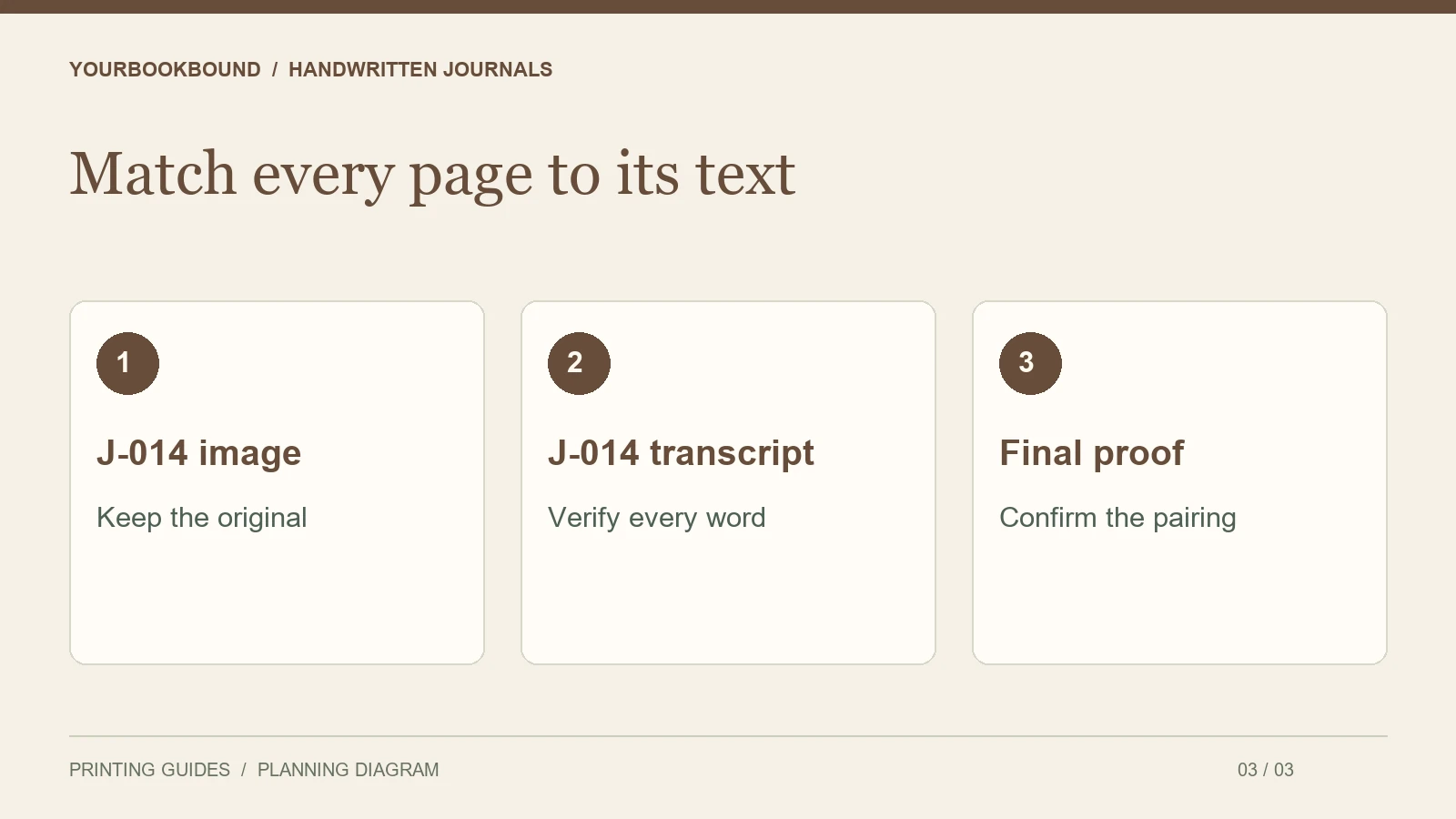
For a mixed edition, assign each source page a stable identifier such as J-014. Use it in the image filename and at the start of the working transcription. After layout, the printed page number may change; the source identifier keeps you from pairing a passage with the wrong handwritten page.
If you use handwriting recognition to help type entries, treat the output as a draft. Check names, dates, numbers and crossed-out words against the image. Mark an unreadable passage consistently, for example with an editorial note in square brackets, and explain that convention at the beginning of the book.
Make corrections on a working copy. Preserve the original capture separately, especially when cropping stains or changing contrast would remove a mark that has meaning. The printer needs your selected digital edition, not access to the entire private archive.
Will YourBookBound scan my physical journal?
Do not send irreplaceable originals without a separately agreed arrangement. The standard workflow starts with your completed digital text and images; scanning and transcription are not assumed services.
Can I preserve handwriting and still have readable text?
Yes, you can prepare both for a mixed layout. Submit your digital material and preferences for a free file check. The team can review how it might fit a hardcover before you finalize the book.