
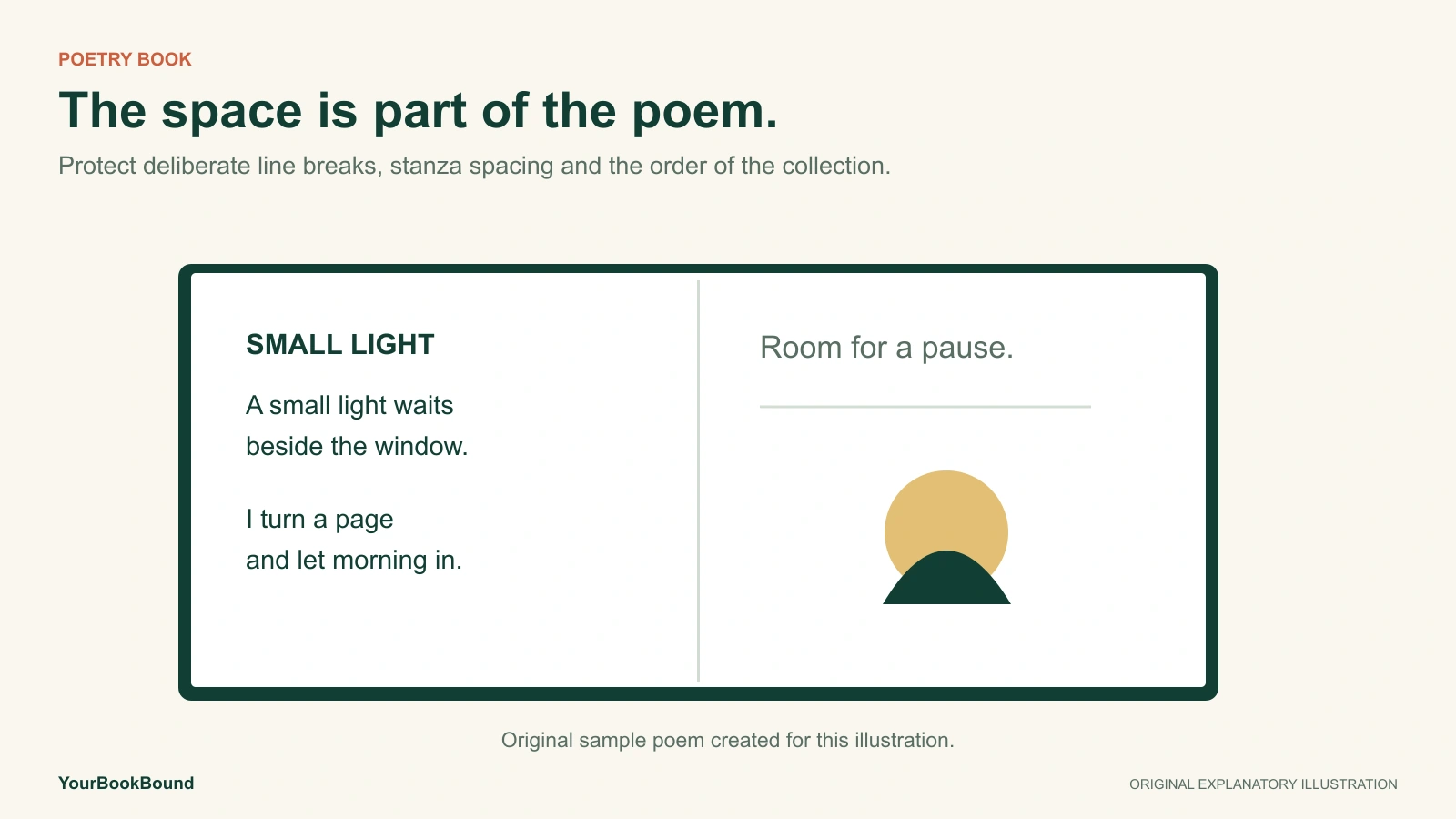
To print a poetry book, gather your finished poems into one complete document, choose a book size, and check how the layout preserves your line breaks and stanza spacing. For one personal hardcover, the crucial step is approving a complete digital proof against your intended text and appearance before the book goes to print.
What kind of poetry book are you making?
A collection for your bookshelf, a gift for a parent, and a booklet to sell after a reading can need different products. Decide who will hold the book and how they will use it before choosing a format.
This guide focuses on a personal hardcover made from poems you have already written. One copy can be the entire project. You do not need to develop a retail publishing plan to give someone a physical collection of your work; our personal-use book printing guide explains that route.
If you specifically want a slim, stapled chapbook for an event, compare services offering that binding. A hardcover keepsake and a stapled booklet answer different needs. YourBookBound’s offer is a custom hardcover, and the preparation service covers your completed content. It does not promise poem writing, literary editing, bookstore placement or retail distribution.
How should you organize your poems before layout?
Start with one master collection. If poems are spread across phone notes, email drafts and separate documents, copy the final text into an editable manuscript in the intended order. Keep the original files separately so an accidental change does not become your only version.
Make a simple contents list even if you do not want a printed contents page. For each poem, record its title, its position in the collection and any layout instruction that matters. “Begin on a new page” or “keep these two stanzas together” is more useful than a general request to make everything look poetic.
- Choose the reading order: chronological, by theme, or an intentional progression from one mood to another.
- Decide the opening pages: title, author name or pen name, dedication and an optional contents page.
- Mark section breaks: name them consistently and decide whether each needs its own page.
- Identify exceptions: untitled poems, unusually long lines, shaped text or a poem spanning several pages.
- Check every contribution: supply text and images you own or have permission to reproduce.
You can decide page numbers after the layout takes shape. Attaching permanent page references too early creates unnecessary work when a dedication or section divider moves the rest of the collection.
How do you protect line breaks and white space?
In poetry, a line ending can carry meaning. A new line created by the author is different from an automatic wrap caused by the width of a text area. BookBaby’s poetry formatting guidance emphasizes the role of line breaks, stanza structure and white space, while recognizing that poetry has no single universal layout.
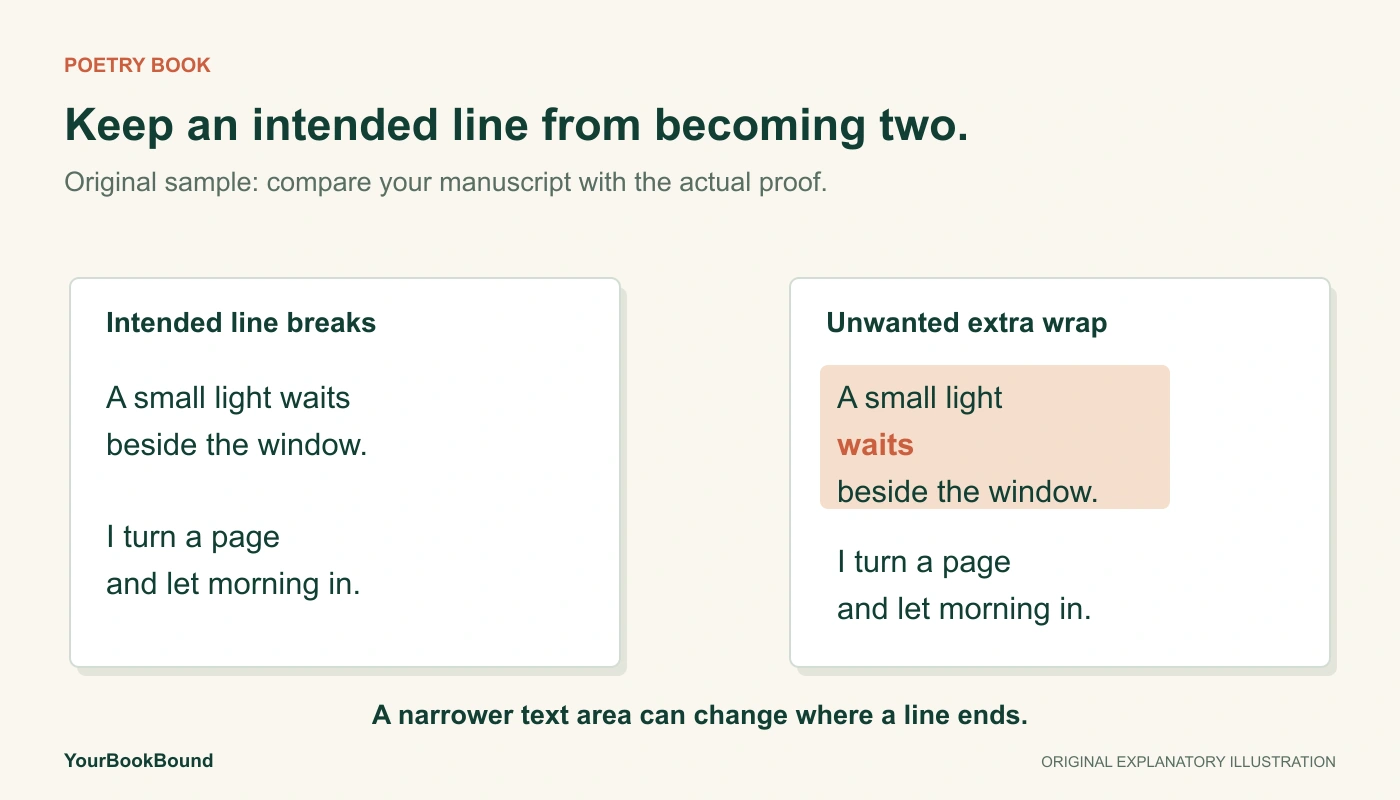
Here is an original example with four deliberate lines and a gap between the two stanzas:
A small light waits
beside the window.I turn a page
and let morning in.
If “A small light waits” wraps after “light,” the page has introduced a fifth visible line. That might be acceptable to an author, or it might change the intended rhythm. The printer should not have to guess.
Test three demanding pages first: the poem with the widest line, the longest poem, and the poem with the most intentional spacing. These reveal different constraints. A short centered poem might fit almost anywhere, while a long line exposes a narrow text area immediately.
If the sample fails, consider the book size, margins and typeface together. Do not shrink the entire collection just to fit one difficult line. You may prefer a larger page or an author-approved exception for that poem. Record the choice so it survives later changes.
For shaped or spatial poetry, include a visual reference and identify which alignments are intentional. A column of spaces that happens to look right on your laptop is not sufficient evidence that the final book will reproduce it correctly.
Which book size and paper suit your collection?
YourBookBound’s common sizes are A5 (148 × 210 mm), A4 (210 × 297 mm), and US Letter (8.5 × 11 inches). A5 may suit a compact collection with shorter lines. A4 or US Letter provides more room to explore longer lines or spatial arrangements. The correct choice comes from testing your poems, not from a fixed rule about poetry books.
View or print a representative page at its intended physical size. Check whether the text feels comfortable to read and whether the surrounding space looks purposeful. Zooming in on a phone can hide how small text will be on paper.
Common paper options are uncoated woodfree paper, also called offset paper, and double-sided coated art paper. Explain whether your collection is mostly text or includes photographs and artwork. Confirm the actual paper and production plan during the file check; do not infer a particular paper weight or finish from a sample photograph.
There is no page-count limit in YourBookBound’s offer. Your number of poems is not your number of pages: opening matter, section dividers, longer poems and deliberate blank pages all contribute. Build the collection your work needs, then confirm its size, paper and final page count together.
Should you send a PDF or an editable document?
Keep two useful versions: an editable manuscript for preparing the book, and a reference PDF showing the appearance you intend. Label their roles clearly. For example, “The DOCX controls the final wording; the PDF shows the intended line endings and stanza gaps.” If the two disagree, resolve that difference rather than leaving someone else to choose.
A PDF is useful when the arrangement is already deliberate. An editable document gives the preparation team more flexibility when layout still needs work. The PDF versus DOCX guide explains the practical difference. Neither format removes the need to review the resulting proof.
Lulu’s manuscript preparation guidance describes using styles and checking nonprinting characters to find inconsistent formatting. For poetry, apply that inspection carefully: a stanza gap, indent or manual line break may be intentional. Do not clear all formatting from your only copy, and do not replace the entire collection with screenshots just to freeze its appearance.
YourBookBound accepts a complete interior in PDF, DOC, DOCX or RTF, up to 100 MB per file. Loose poem screenshots and separate JPG pages are not accepted interior upload formats. Put the entire collection in reading order and follow the current file guide. A separate finished cover is optional for the initial check.
Useful handoff note: “Please preserve deliberate line endings and stanza gaps. The three marked poems need special spacing. Please flag any line that must wrap at the agreed size.” This gives the preparation team specific decisions to bring back to you.
What should you check in the digital proof?
Review the complete proof in two passes. The first protects each poem; the second protects the experience of reading the collection. Trying to do everything in one quick scroll makes small changes easy to miss.
Pass one: compare the poems line by line
- Compare wording, punctuation and capitalization with the final manuscript.
- Check every intended line ending and any new automatic wrap.
- Compare stanza gaps, indents and alignment with the reference.
- Inspect longer poems for awkward splits and missing or repeated lines.
- Check special characters and unusual typography at a readable zoom.
Write corrections with a proof page number and a precise instruction: “Page 18, poem ‘Window,’ restore the blank line after line 2.” If you supply new text, identify it as a replacement so it does not become an additional poem by mistake.
Pass two: read the book in order
- Check that every poem appears once and in the agreed sequence.
- Check the title page, author name, dedication and section dividers.
- Match contents entries and page references to the finished layout.
- Review page turns and intentional blank pages as part of the reading rhythm.
- Check the cover wording and spine against the interior title and author name.
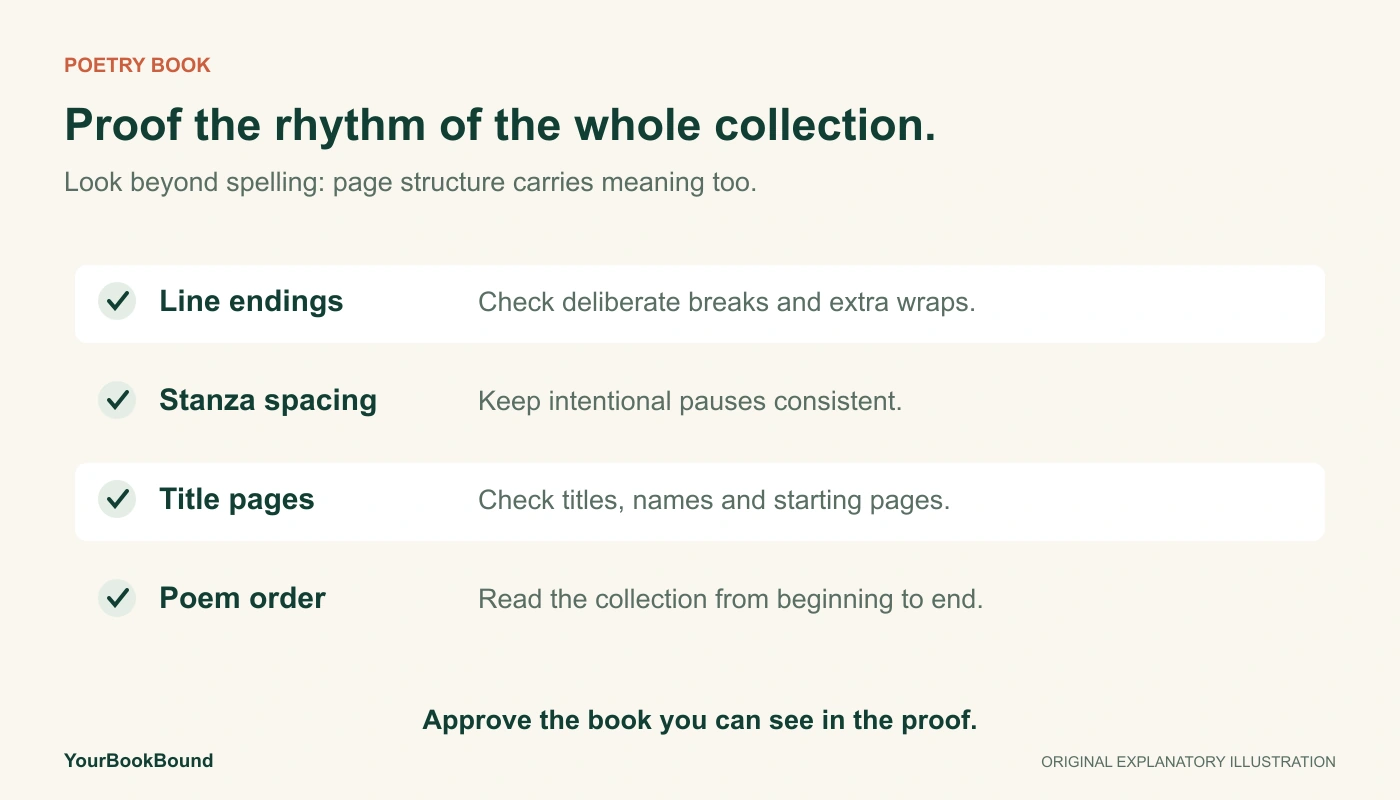
Repeat the relevant checks after revisions. A change near the beginning can move later pages. A digital proof lets you review content and layout, but it cannot demonstrate paper feel or guarantee exact printed color.
What does one custom hardcover poetry book cost?
YourBookBound charges $99 USD per hardcover copy. That includes human file review, technical corrections, interior layout and formatting, cover design or adjustment with spine setup, a digital proof and revisions before approval, one finished hardcover and standard tracked shipping. Each additional copy is also $99. See the current pricing and included services.
There is no separate layout, cover, handling, production or standard-shipping charge. Government import duties or taxes, if applicable, are separate. Available payment methods and any provider charges appear on the payment page.
The process starts with a free human file check, with no payment at upload and no obligation to order. Confirm the specifications, number of copies and destination, then choose whether to pay. Book preparation, digital proof and revisions follow payment; printing starts after your approval. The free check does not include a free physical sample.
Is your poetry collection ready for a free file check?
Send your complete interior in PDF, DOC, DOCX or RTF, within the 100 MB per-file limit. Include your preferred size and a note about the line breaks, spacing or page turns you want protected. You can submit finished poems even if the book formatting still needs help.
The first step is a human check of your files and production plan. You decide whether to order after that review.