
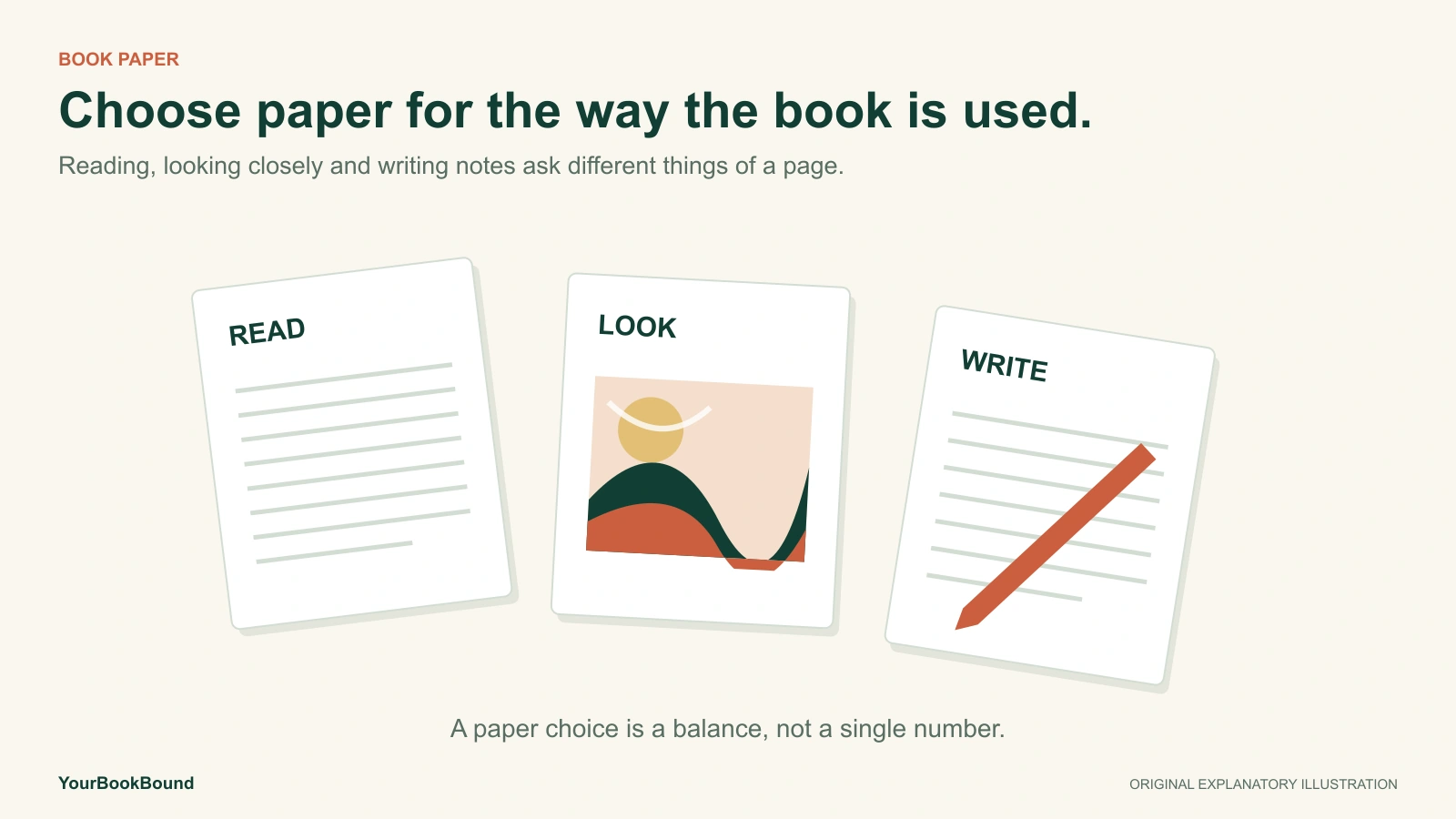
Choose coated or uncoated book paper by what readers will do with the pages. Compare coated stock when image appearance is the priority; start with uncoated when reading feel or writing space matters most. Neither label determines thickness, opacity or every printing result. For a mixed book, identify the essential use, then confirm the actual stock with the printer.
What changes between coated and uncoated paper?
The main distinction is the paper’s surface treatment, not whether the book is inexpensive or premium. Coated papers receive a coating during manufacture. Uncoated papers do not have that same coating. The surface affects how the printing process interacts with the sheet, as well as its appearance and feel.
Coated stock is a useful starting point when you want to compare the appearance of photographs or detailed illustrations. Uncoated stock offers another visual and tactile direction. It should not be dismissed as suitable only for black text: Mohawk’s manufacturer guide discusses successful four-color printing on uncoated paper and the importance of choosing the grade and preparing the print correctly. Its technical advice concerns offset printing, so individual press settings should stay with the production team. Mohawk’s uncoated-paper printing guide explains those distinctions.
For your decision, replace “Which paper is better?” with a more useful question: “Which available paper supports the way this particular book will be read and handled?” A collection of letters, a picture-led keepsake and a workbook can call for different priorities even when all three contain color.
Which paper should you consider for reading, pictures or writing?
Start with the activity that matters most, then check the secondary uses. Use these three routes to prepare your conversation with the printer.
- Mostly reading: compare the actual uncoated option for its surface, paper shade and text appearance. If an available coated option has a quieter finish, compare that too. Read a full page under the light in which the book will normally be used.
- Mostly viewing images: compare the coated option using your own detailed, pale and dark artwork. Judge whether its image treatment suits the work, and whether you like the surface. An uncoated treatment may still be an intentional creative choice.
- Writing, coloring or adding notes: start by discussing uncoated paper and name the intended tool: pencil, colored pencil, ballpoint or something else. PrintNinja uses uncoated interiors for its activity-book examples, but that does not establish that every uncoated sheet works with every pen or marker. Its activity-book guidance gives the relevant use case.
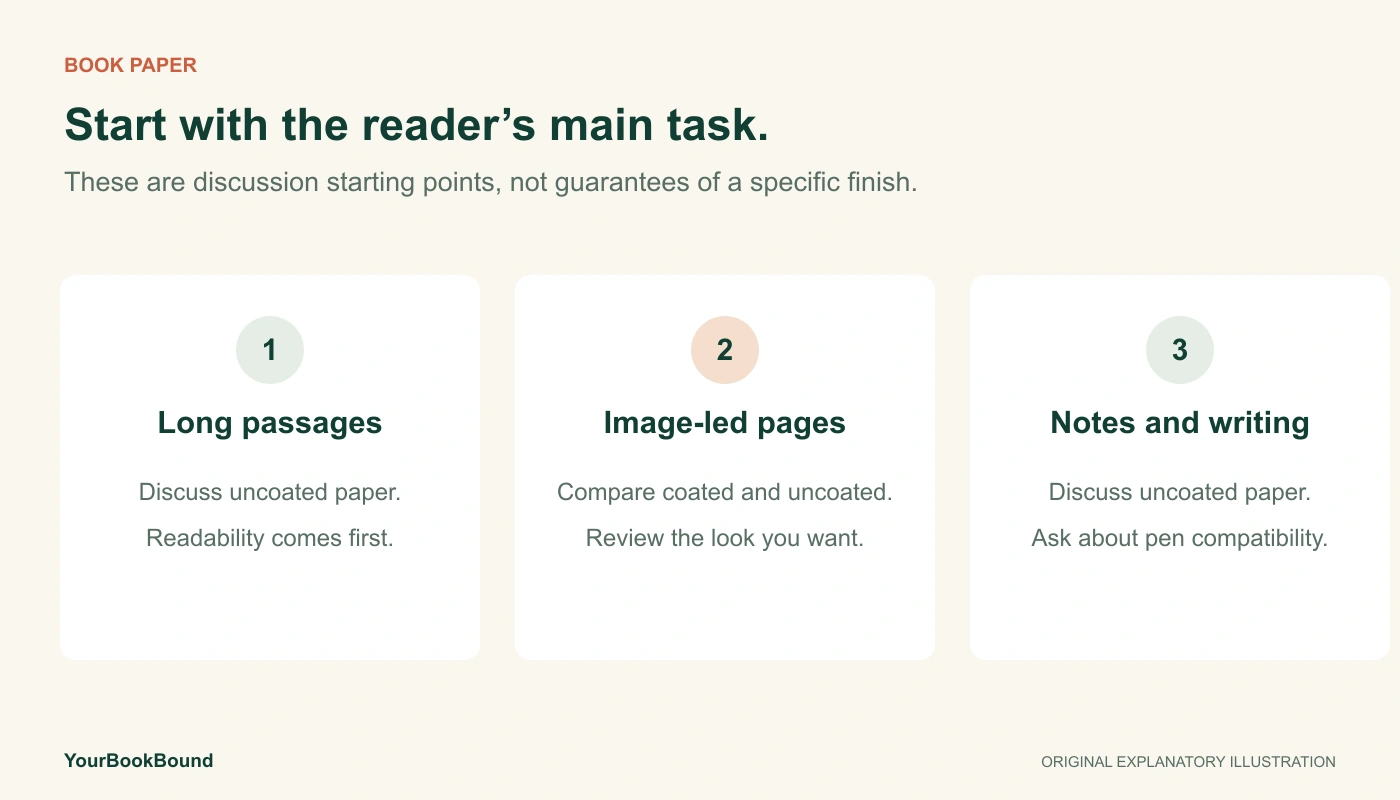
Practical inference: protect the task the reader cannot do without. If a family recipe book must accept handwritten changes, writing compatibility is a functional requirement. If it is a gift for browsing photographs and stories, image appearance may lead. This priority rule follows from the different surface uses; it is not a universal ranking of papers.
For a mixed book, write one sentence before choosing: “This book is mainly for ___, and readers also need to ___.” That makes the tradeoff visible. It is more helpful than selecting a paper because one genre is supposed to use it.
Does coated paper always mean glossy, and is it the same as a cover finish?
No. Coated paper can have different finishes, and an interior paper coating is separate from a finish applied to a printed cover. PrintNinja distinguishes manufacturing-stage paper coatings from finishing after printing, and describes both gloss and matte as coated options. Its paper-coating guide is useful for separating those terms.
A request for “matte paper” therefore needs clarification. Do you mean a surface with less shine, or specifically an uncoated sheet? Those descriptions are not interchangeable. Sappi’s book-paper range illustrates why: different grades emphasize different combinations of surface appearance, bulk and image reproduction. These are manufacturer examples, not a list of papers offered by every printer. See Sappi’s book-paper descriptions.
Ask for the exact available interior stock before assuming a particular matte or gloss finish is included. Decide the outside of the book separately; our cover-finish guide addresses that different choice.
Do paper weight, thickness and opacity answer the same question?
No. They describe different properties, so a heavier-sounding number is not a complete paper specification. Keep these questions separate:
- Coating and finish: what is the surface treatment and appearance?
- Weight: what mass of paper is being specified, using which measurement system?
- Thickness: how thick is the actual sheet, and what does that mean for the finished book?
- Opacity: how much does printing on the reverse become visible through the page?
Sappi’s specification sheet reports these properties separately and shows that sheets with the same basis weight can have different thicknesses. That historical document is useful for understanding the distinction, not for choosing today’s stock from its old catalog. Sappi’s paper specification table provides the example.
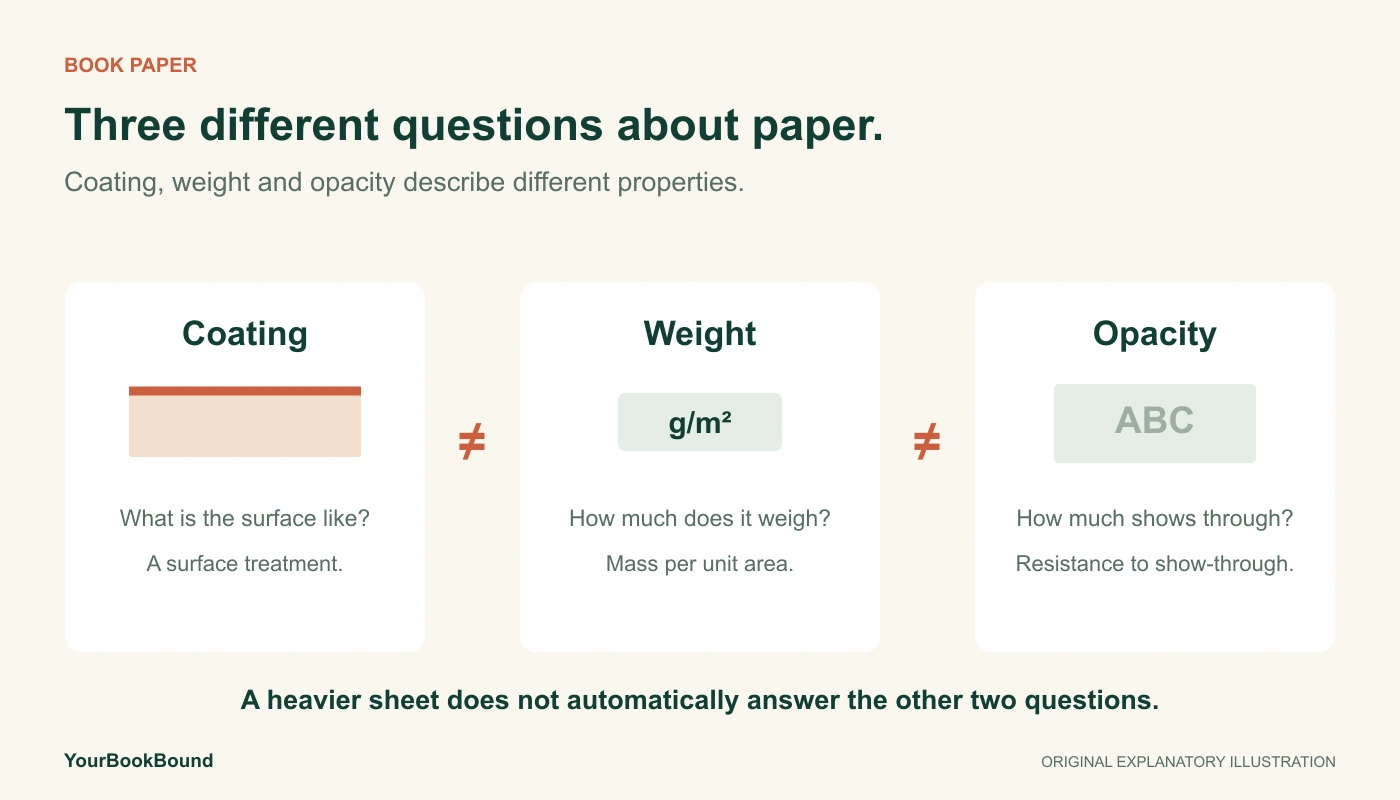
If your book pairs dark artwork with pale pages, ask about show-through on the actual stock rather than inferring it from the coating label. If the book has many pages, ask how the chosen sheet affects its overall construction. There is no single paper-weight recommendation that resolves both questions for every book.
How can you compare paper using your own book?
Choose representative pages that expose different needs, and separate screen checks from physical paper checks. A digital proof helps you review content and layout. It cannot let you feel a surface, try a pen or see the exact effect of room lighting on paper.
When real printed samples are available, compare the same text or image across stocks. PrintNinja uses repeated images in its sample pack for that purpose. That is a useful comparison method; it does not mean YourBookBound includes or sells that sample pack. See how the sample comparison is organized.
For your own file review, mark the page numbers of:
- Your densest ordinary reading page, including any small captions.
- An image with dark areas or fine detail that matters to you.
- A pale illustration or photograph whose subtle appearance matters.
- A page people will write or color on, if there is one.
- A facing-page pair where the two sides have very different amounts of ink.
Practical inference: compare the difficult pages, not only the prettiest one. These pages create different questions about surface, image treatment and show-through. Using them as a review set is an editorial method drawn from the separate paper properties and same-image sample approach, not a claim that a screen can measure print performance.
Describe what must be preserved: legible handwriting, visible shadow detail or space for pencil notes. If printed color is your concern, the color-file preparation guide covers the separate file conversation. Changing paper is not a substitute for checking the artwork.
A paper test you can run before committing to a book
Make the decision with a small set of your own pages. A blank swatch can tell you about surface and stiffness, but it cannot show how your photographs, reverse-side printing or handwriting will behave. The following is an original comparison worksheet, not a laboratory test or a report of samples we have tested.
Prepare two comparable candidates
Ask which two stocks are actually available for your size, page count and binding. Label them A and B with the supplier’s exact description, grammage and sample date. Record whether the samples were printed on the intended production system. If one is an unprinted swatch and the other a finished book, keep both, but do not score them as though the printing conditions matched.
Gather your intended writing tool, a ruler, a lamp and daylight access. Use a spare approved sample for pen or eraser tests; do not mark a borrowed sample book. Ask whether a printed test or physical proof is available and what it costs. A request for a paper comparison does not mean that two physical proofs are included in an order.
Write down your non-negotiable task first. For a recipe book it might be “the owner must be able to add a ballpoint note without it transferring to the opposite page.” For a photo essay it might be “the detail in this dark jacket must remain distinguishable.” A paper that fails the main task does not win merely because its surface feels expensive.
Build the comparison file from four difficult pages
Copy the pages below from your actual project into a clearly named test file. Keep the intended trim size, image size, text size and export settings. Label the file as a test so that it cannot be mistaken for the complete interior. Have the printer confirm how to submit it and whether the chosen construction needs additional pages.
| Test page | What to put on it | What to check physically |
|---|---|---|
| 1: reading | A full ordinary paragraph, your smallest real caption and one heading | Read at a normal distance under your usual lamp. Note whether moving the book is necessary to avoid reflections. |
| 2: image | One dark image, one pale image and a face if portraits are part of the book | Name a particular detail you need to see. Compare it on both stocks under the same light, not against a bright phone screen. |
| 3: writing | A real exercise or notes area, including any pale printed rules | Write a sentence with the intended tool. At recorded intervals, gently rub a spare test mark and check the facing sheet for transfer. |
| 4: reverse-side stress | A dark image behind the reading or writing area, positioned as it would be in the book | Read the front normally. Record distracting show-through separately from ink that physically penetrates the sheet. |
Do not hold the page against a bright window to decide whether normal reading show-through is acceptable. That creates a different condition. If backlighting is part of the intended use, record it as a separate test. Likewise, testing a pencil does not establish compatibility with fountain pens or alcohol markers.
For a bound sample, also open it naturally and try writing near the inner edge. Do not force it flat. A stock may pass the loose-sheet pen test while the binding makes the writing task awkward. That requires a layout or construction decision, not merely another paper weight.
Record observations before choosing a favorite
Copy this table and replace the example entries with your own. The observations below are fictional demonstrations, not results for any named stock.
| Requirement | Candidate A: hypothetical observation | Candidate B: hypothetical observation | Decision |
|---|---|---|---|
| Ballpoint notes remain usable | Test word transfers to spare facing sheet at 30 seconds | No visible transfer at the recorded 30-second check | A fails this project’s note-taking requirement; B passes this limited test with this pen |
| Food photographs remain understandable | Preferred surface appearance | Less shiny; all ingredients in the selected image identifiable | Both meet the functional requirement; appearance is a preference |
| Read directions under kitchen light | Need to tilt the page to move the lamp reflection | Can read at the chosen angle | B better fits this particular setting |
| Write close to binding | Not tested: loose sample | Not tested: loose sample | Still unresolved; request construction guidance or move notes outward |
In this example, choose B provisionally for a working recipe book and resolve the binding question before approval. For a display-only edition with no handwriting, A might remain a candidate. The same samples can produce different sensible decisions because the reader’s task changed. “Not tested” must stay visible; a blank cell is not a pass.
Check the weight consequence without guessing the spine
Grammage measures mass per area. For an ordinary duplex interior, 120 pages occupy 60 leaves. An A5 leaf is 0.148 × 0.210 = 0.03108 square metres. A first approximation for the mass of the trimmed interior paper is:
leaf area in m² × number of leaves × grammage in g/m²
At a hypothetical 100 g/m², that is 0.03108 × 60 × 100 = 186.48 g. At 150 g/m² it is 279.72 g, a difference of 93.24 g. These are example weights, not our stock options. They exclude the case, endsheets, adhesive, ink, packaging and any special mounted-page construction. They are not shipping weights or a spine-width formula.
Paper thickness needs the actual stock’s caliper and the binding specification. Two stocks of equal grammage need not produce the same book thickness. If portability matters, ask for a finished-book estimate after the complete specification is known.
When neither paper passes
- If both show distracting reverse printing, move the darkest image away from a writing page and ask about a more opaque compatible stock. Simply calling the paper “matte” does not solve opacity.
- If both obscure small text, check type size, contrast and the exported file before blaming the sheet. A paper upgrade cannot restore a clipped caption.
- If neither accepts the required tool, change the tool, redesign the activity or ask about another production option. Do not describe the finished book as marker-friendly without a relevant test.
- If samples were printed differently, ask for a matched comparison or state that the choice is provisional. Do not turn an unmatched sample preference into a color guarantee.
Keep the winning sample ID, test file name, observations and unresolved questions with the job. A later substitute stock should trigger another review of the affected requirements. That record is more useful than “we chose the nice thick paper.”
Further reading: Blurb’s paper-selection overview helped identify the questions worth testing; its product catalog and longevity claims are not specifications for YourBookBound. Sappi’s paper range also illustrates that surface, bulk and image reproduction are distinct product characteristics. The test plan, fictional observations and arithmetic above are our original teaching examples.
What should be checked if you change paper late?
Reconfirm the production specification and cover preparation before approving the book. Do this even when the interior page count stays the same.
Practical inference: a paper change is a cover checkpoint too. Because sheet thickness is a separate property, a previous spine setup should not be assumed to fit a different stock. Ask the production team to confirm the final construction and spine rather than calculating them from a generic paper-weight chart.
Keep a short record of the agreed size, paper description and final page count. If any changes, request confirmation of the revised specification and inspect the relevant proof again. That keeps “the paper we discussed” tied to the book you actually approve.
What should you confirm before ordering your hardcover?
Confirm the available stock against your use case, not against an assumed universal specification. YourBookBound’s common options are uncoated woodfree paper, also called offset paper, and double-sided coated art paper. Common sizes are A5, A4 and US Letter, 8.5 × 11 inches. There is no page-count limit; the final size, paper, pages and production plan are confirmed together.
The file and specification guide explains what to submit. You can include this short note with your completed content:
This book is mainly for [reading / viewing images / writing]. My preferred size is [size]. Please review pages [numbers], especially [detail or use that matters]. I am considering [paper], but would like the available stock and final cover setup confirmed before approval.
Do not infer waterproofness, archival life or special binding behavior from the word “coated.” If one of those properties is essential to the project, ask for a specific supported answer before ordering.
Ready to check your pages and paper choice?
Start with a free human file check, with no payment or obligation to order. If you proceed, $99 USD per hardcover copy includes technical file corrections, interior layout and formatting, cover design or adjustment and spine setup, a digital proof and revisions before approval, one hardcover and standard tracked shipping.
Upload the complete interior in its intended order as a PDF, DOC, DOCX or RTF file, up to 100 MB per file; individual image files are not interior uploads. Include the paper questions that matter to your book. The initial check confirms the next steps; printing begins only after payment and proof approval.