
To turn a family story into a book, choose one intended reader, inventory the material, protect the originals, organize the story, clear permissions, and settle every name, date, caption, and page before approving the proof.
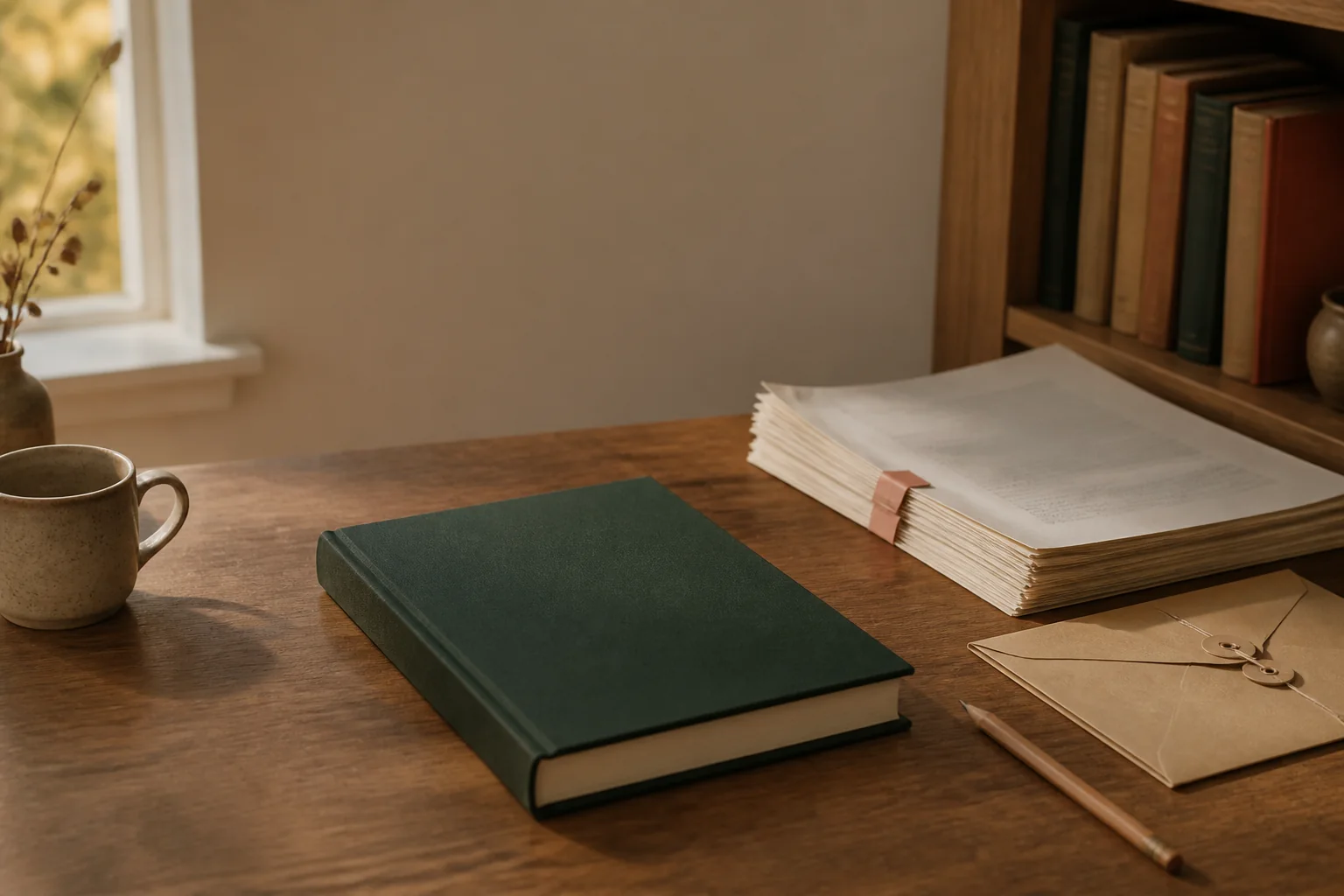
A practical family story book workflow
Do not begin by choosing a cover. Begin by deciding whose story the book tells and who should read it. A book for one grandchild makes different choices from a family history meant for every branch of a large family.
The work usually moves through five stages:
- Define the reader and the boundaries of the story.
- Gather and label the source material.
- Draft, verify, and permission-check the content.
- Arrange the material into finished pages.
- Read the proof as carefully as you would read a family record.
This process can produce a memoir, a family history, a tribute, a recipe book with stories, or a short keepsake for one person. The first version does not need to contain everything the family knows. A narrow finished book is more useful than a permanent folder called “someday.”
Choose one reader and one purpose
Write a one-sentence brief before collecting more material. For example: “This book tells my mother’s childhood story for her grandchildren.” That sentence helps you decide what belongs and what does not.
Answer these questions in plain language:
- Who is the main subject?
- Who will receive the finished book?
- What period or part of the person’s life will it cover?
- Will the book remain private, or might it later be shared or sold publicly?
The last question can remain provisional, but record the answer. A private family copy still requires care with other people’s photographs and writing. A future public edition may require a broader permissions and editorial review.
Make one source inventory
Family material tends to arrive in pieces: a phone recording, a box of photographs, a handwritten recipe, a certificate, an email, and somebody’s corrected version of the same date. Put every item on one inventory before building pages.
| Source | Record with it | Question to resolve |
|---|---|---|
| Photograph | People, place, approximate date, photographer, current holder | Do you have a usable scan and permission to reproduce it? |
| Letter or diary | Writer, recipient, date, page order, owner of the original | Will you quote it, reproduce it as an image, or paraphrase it? |
| Interview | Speaker, interviewer, date, recording file, consent note | Which statements need another source or a family check? |
| Official record | Record type, person, date, repository, reference number | Does it confirm or contradict the family account? |
| Recipe, drawing, or poem | Creator, date, original location, related story | Who owns the work and what context will the reader need? |
Give each item a simple identifier, such as `PHOTO-014` or `INTERVIEW-MARIA-01`. Use the same identifier in the draft and the file name. This small habit prevents a low-quality screenshot from replacing the better scan or an unidentified face from reaching the final proof.
Protect the originals and work from copies
A hardcover can make family material easier to read and share. It is not an archival storage system.
The U.S. National Archives says that preventing damage is central to preserving family papers and photographs. Its guidance recommends storing originals without folding or bending them and using containers that fit without being overstuffed. For photographs, it advises handling the edges, supporting the item with two hands, and avoiding contact with the image area.
Work from scans or copies when practical. The National Archives also recommends displaying copies while keeping originals protected because light can fade or darken paper and photographs. The same principle suits bookmaking: place the reproduction in the page layout and return the original to appropriate storage.
Keep three things separate: the physical originals, the highest-quality digital master files, and the smaller working copies used in the book layout. The printed book does not replace any of them.
Record family interviews with permission
Ask the person before recording. Explain the intended book, who may receive it, and whether you want to quote them by name. If the scope changes later, ask again instead of treating the first conversation as unlimited permission.
Use questions that invite a scene rather than a résumé:
- What did the kitchen look and smell like?
- Who was present that day?
- What happened next?
- Which part might another relative remember differently?
Save the original recording, make a transcript, and mark uncertain words. Do not quietly “improve” a quotation until it says something the speaker did not say. Light editing for clarity can help, but the speaker should review sensitive or substantial quotations before the book is finalized.
Choose a structure the reader can follow
Three structures cover most family projects:
- Chronological: childhood, school, work, family life, later years. This works when one person’s life is the spine of the book.
- Thematic: home, food, migration, work, celebrations, letters. This works when the material comes from several people or generations.
- One event or relationship: a migration, a family business, a marriage, a shared house, or letters between two people. This keeps a short book focused.
Make a page-level outline before writing the final prose. List each chapter, the evidence it uses, the images it needs, and any unresolved question. Move or delete index cards, rows, or notes now. Rearranging a finished layout is slower.
Use dates where they help, but do not invent certainty. “Summer 1968, according to Elena” is more honest than a precise date nobody can support. If two relatives disagree, the disagreement may belong in the book.
Review permissions, copyright, and sensitive details
Owning the paper photograph is not always the same as owning the copyright in the image. The U.S. Copyright Office states that copyright protects original photographs and writing once they are fixed in a tangible form. The person who took a photograph is generally its author and initial owner, although employment, work-for-hire agreements, contracts, assignments, wills, and other transfers can change ownership.
Create a permissions list beside the source inventory. For each photograph, illustration, poem, letter, or substantial quotation, record why you believe you may reproduce it. If permission is needed, keep the written reply with the project files.
Privacy deserves a separate pass. Ask before including a living person’s sensitive story or identifiable photograph. Remove details that do not serve the book, especially children’s full names, medical information, financial information, precise home addresses, or private conflicts. A small private print run reduces exposure, but it does not make every inclusion wise or lawful.
This is practical project guidance, not legal advice. Copyright, privacy, publicity, and data-protection rules depend on the material, its age, the people involved, the planned audience, and the applicable jurisdiction. Get qualified advice when ownership or permission is unclear.
Edit names, dates, captions, and contradictions
Family books fail in small places. A surname loses a letter. Two cousins are swapped in a caption. A photograph is placed ten years too early. These errors can outlive a beautiful layout.
Run a separate fact pass after the prose edit:
- Make a master spelling list for every person’s name.
- Build a simple timeline of dated events.
- Check every caption against the source inventory.
- Mark uncertain dates and identities honestly.
- Ask one relative who knows the people and one fresh reader to review the draft.
Do not send ten slightly different drafts to the designer or printer. Name one file as the authoritative manuscript, add a date or version number, and record all later corrections in one place.
Build the pages and prepare one authoritative file
Once the content is settled, decide how the reader should move through the book. A simple family history may need a title page, a short introduction, chapters, captions, acknowledgments, and a source note. A longer project may also need a family tree, timeline, endnotes, or index.
Use original image files where possible. Images pulled from messaging apps, social posts, or email previews may be smaller than the source. Keep faces away from folds and important text away from page edges. Exact image, margin, bleed, and cover requirements depend on the final book specification, so use the production provider’s instructions instead of guessing a universal number.
YourBookBound accepts a complete interior as PDF, DOC, DOCX, or RTF. A separate cover is optional at the initial check. Use PDF when the page design is final. Use an editable document when the content is complete but the book still needs page preparation. The file guide lists the current accepted formats and upload limits.
The service starts with a finished interior. It does not include interviewing relatives, family-history research, substantive editing, scanning an archive, creating illustrations, or deciding copyright ownership. Complete those steps before the production handoff.
Review the proof as a family record
A production review can catch technical problems. It cannot know that Aunt Teresa was called Tess, that the house number should be 41, or that the person in the back row is Sam rather than his brother.
Read the proof in passes:
- First pass: page order, missing pages, blank pages, and chapter openings.
- Second pass: names, dates, quotations, captions, and family relationships.
- Third pass: image crop, orientation, sequence, and readability.
- Final pass: cover, title, author credit, spine text, and the first and last page.
Record corrections by page number and exact replacement text. Approve only the corrected proof you intend to print. The production workflow explains where YourBookBound’s digital proof fits after the file check.
Keep the archive after the book is printed
The finished hardcover is an access copy and a keepsake. Keep the source inventory, permissions, interview recordings, transcripts, original image files, editable manuscript, and final PDF in a backed-up project folder. Store physical originals according to appropriate preservation guidance.
If the book may later become public, keep notes about uncertain facts and restricted items. A photograph approved for a few relatives may need a new permission conversation before a retail edition, public website, or social campaign.
If you only want one private copy now, read how private printing differs from publishing. That decision comes after the family material is organized, not before.
Frequently asked questions
How long should a family history book be?
Long enough to complete the chosen story. A focused book about one person or event can be more coherent than a large volume that tries to document every branch of a family. YourBookBound has no page-count limit: choose the length your story needs. We confirm the final size, paper and page count with you during the free file check.
Should I scan every family photograph?
No. Inventory the collection first, then select photographs that add evidence or meaning to the chosen story. Keep the originals protected and preserve higher-quality master scans separately from the copies used in layout.
Can I include old family letters and photographs?
Age, possession, and family connection do not by themselves settle copyright or privacy. Identify the creator and current rights holder where possible, record your permission basis, and obtain appropriate advice when ownership is unclear.
Can the book stay private?
Yes. A family book can be produced without a retail listing or public release. Private use does not remove the need to handle other people’s work and personal information carefully.
What should I upload for an initial file check?
Upload one complete interior in PDF, DOC, DOCX, or RTF, using the version you want reviewed. A separate cover is optional. Do not upload identity documents or payment information with the book files.
Finished family story, one physical copy
Have the complete interior checked before you order.
Submit the finished manuscript or page file for a free initial review. No payment is required at upload, and there is no obligation to order.
Official references
- U.S. National Archives: How to Preserve Family Archives
- U.S. National Archives: Storing Family Papers and Photographs
- U.S. National Archives: Displaying Family Papers and Photographs
- U.S. National Archives: Photograph Handling and Preservation
- U.S. Copyright Office: What Is Copyright?
- U.S. Copyright Office: What Photographers Should Know About Copyright